

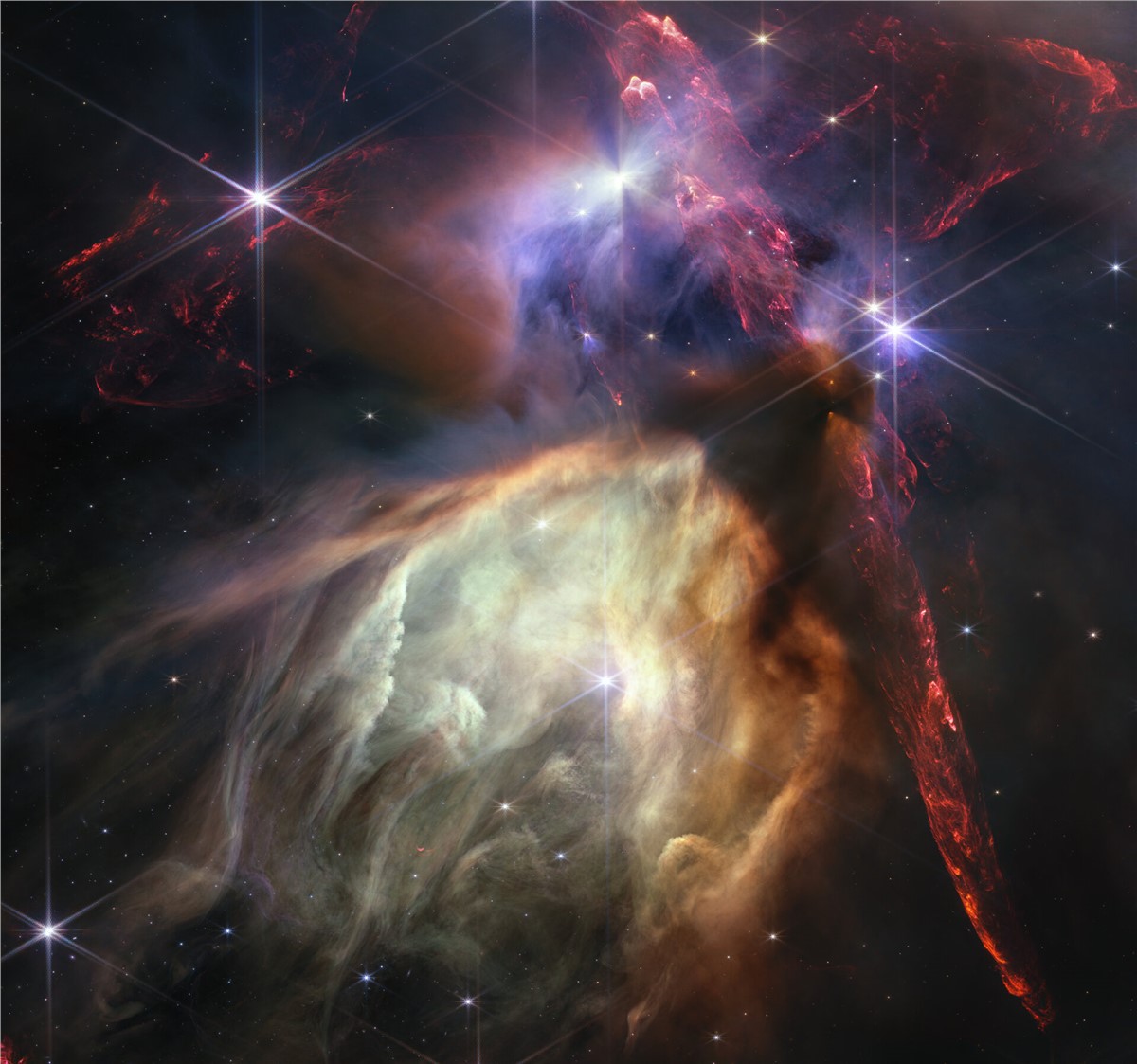
In its first year of science operations, the NASA/ESA/CSA James Webb Space Telescope has lived up to its promise of unveiling the Universe in unprecedented ways. To commemorate this successful milestone, a new image of a small star-forming region in the Rho Ophiuchi cloud complex has been released. Despite its relatively calm nature, the region’s proximity at 390 light-years allows for a highly detailed close-up without any foreground stars obstructing the view.
The latest image captured by Webb showcases approximately 50 young stars, all similar in mass to the Sun or smaller. The darkest areas represent the densest parts where thick dust cocoons are enveloping protostars that are still in the process of forming. The image is dominated by massive red bipolar jets of molecular hydrogen, which can be seen horizontally across the upper third and vertically on the right. These jets occur when a star bursts through its cosmic dust envelope, propelling opposing jets into space. In contrast, the star S1 has created a luminous cavity of dust in the lower half of the image and is the only star significantly more massive than the Sun.
Furthermore, some stars in the image exhibit shadows that indicate the presence of protoplanetary discs, which could potentially develop into planetary systems in the future.
Since its initial deep field image was unveiled on July 11, 2022, Webb has not only fulfilled its promise of revealing distant galaxies in the early Universe but has also provided scientists with invaluable spectroscopic data. Webb’s spectra, obtained through its spectroscopic instruments, have confirmed galaxy distances, identified atmospheric compositions (or lack thereof) of exoplanets, unveiled the chemical makeup of stellar nurseries and protoplanetary discs, and much more.
Webb’s scientific contributions extend beyond distant galaxies and encompass our very own Solar System. The telescope has captured faint rings surrounding gas giants and their accompanying moons, while also capturing distant galaxies in the background. By comparing the detection of water and other molecules in our Solar System with those found in much younger planetary systems, Webb is aiding in the understanding of our origins and how Earth became a habitable planet.
Although Webb’s first year has been remarkable, its scientific mission is only just beginning. The second year of observations has already been planned, building upon the exciting discoveries made during the first year that have exceeded expectations.




 Copyright 2023 All rights reserved.