

Title: The Pale Blue Dot: A Poignant Reminder of Our Responsibility
Subtitle: Mars Express Celebrates 20th Anniversary with Stunning Images of Earth and Moon
Byline: [Your Name], Space Exploration Correspondent
Image source: ASD News
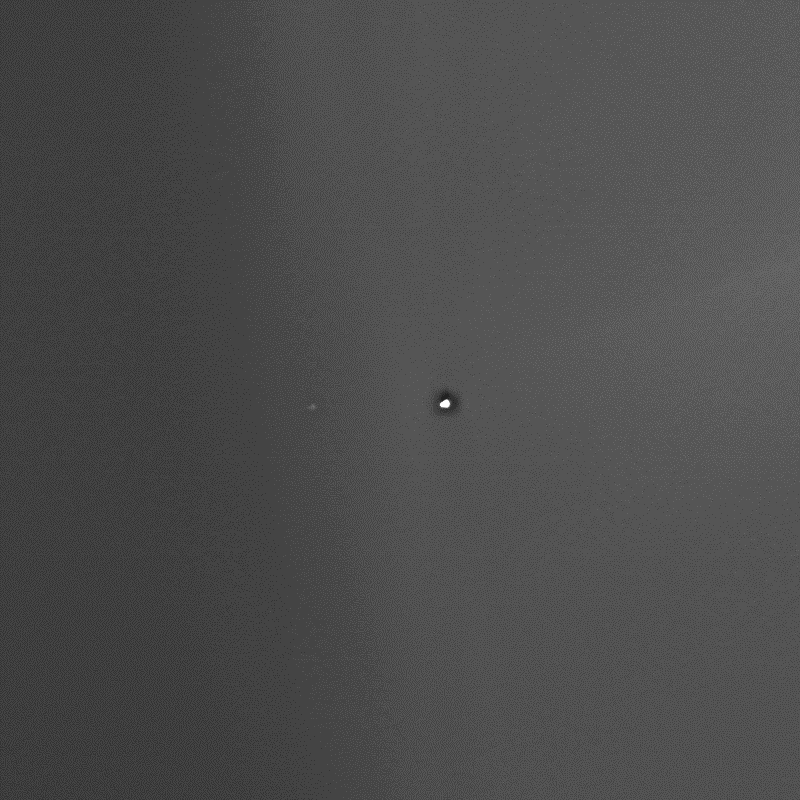
Caption: Earth and Moon as seen from Mars. Image Credit: ESA/Mars Express/HRSC
Date: [Current Date]
You are on Mars, gazing at the distant planet you once called home. How does it make you feel? If you observe closely over several weeks, aided by binoculars, you’ll notice a small white dot orbiting around a larger dot. That’s our Moon, gracefully circling Earth. Despite not being the most awe-inspiring image of Earth and the Moon captured during a space exploration mission, this simple snapshot from ESA’s Mars Express orbiter manages to evoke that poignant ‘Pale Blue Dot’ sentiment.
The term “Pale Blue Dot” was first coined by scientist and communicator Carl Sagan, who drew inspiration from a humbling image taken by NASA’s Voyager 1 in 1990 as it turned its gaze back towards Earth. This image moved Sagan to deliver his influential speech, reflecting on Earth as the only known world to harbor life and emphasizing our responsibility to treat one another with kindness and preserve our precious home planet.
More than three decades have passed since that iconic image was captured, and in that time, numerous space probes have followed suit, capturing images of Earth as they journeyed to various destinations within the Solar System. Rovers and orbiters exploring Mars have also contributed their fair share of snapshots. Yet, Sagan’s message from the 1990s remains more urgent than ever.
“On the special occasion of Mars Express’s 20th anniversary since launch, we wanted to bring Carl Sagan’s reflections back to the present day, where the worsening climate and ecological crisis make them even more relevant,” says Jorge Hernández Bernal, a member of the Mars Express team from the University of the Basque Country and Sorbonne University.
“In these simple snapshots from Mars Express, Earth appears as small as an ant seen from a distance of 100 meters, and we are all in there. Even though we have seen images like these before, it is still humbling to pause and think: we need to look after the pale blue dot, there is no planet B.”
The sequence of images was captured by the super resolution channel (SRC) of Mars Express’s High Resolution Stereo Camera (HRSC), primarily used for observing Mars’s moons and stars. These images depict Earth and its moon on multiple dates in May and June 2023, covering more than half of the Moon’s monthly orbit around Earth.
The final image in the sequence marked the anniversary of Mars Express’s launch on June 2, 2003. It was taken just before a special anniversary event where images of Mars taken by the spacecraft’s Visual Monitoring Camera (VMC) were broadcasted ‘live’ back to Earth for the first time.
“While these images hold no scientific value, the favorable conditions allowed us to point the HRSC towards Earth and shortly after, the VMC towards Mars. We took this opportunity to create our own portrait of home on this incredible mission milestone for Mars Express,” says Daniela Tirsch, a member of the Mars Express HRSC team at the German Aerospace Center, DLR.
Interestingly, the very first planetary image taken by the Mars Express mission 20 years ago was that of the Earth-Moon system. On the night of July 3, 2003, the spacecraft captured a breathtaking view of our planet and moon from a distance of just eight million kilometers while en route to Mars. By comparison, the 2023 images were taken from approximately 300 million kilometers away.
“Perhaps it will only be another 20 years before humans can look up from the surface of Mars to see Earth in the night sky,” adds Colin Wilson, ESA project scientist for Mars Express and the ExoMars Trace Gas Orbiter. “ESA has a long history of Mars exploration, first from orbit with Mars Express and the Trace Gas Orbiter, and in the next decade on the surface with the Rosalind Franklin rover and the completion of the Mars Sample Return missions. The next bold ambition is, of course, to explore with humans.”
So, the next time you gaze up at the night sky and catch a glimpse of Mars, take a moment to ponder Mars Express or the future generation of Mars explorers who may be looking back at us. The Pale Blue Dot serves as a powerful reminder of our responsibility to cherish and protect our fragile home in the vastness of space.




 Copyright 2023 All rights reserved.