

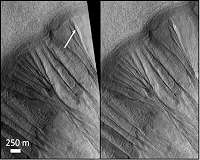
A recent study led by researchers from Brown University has provided new insights into the formation of gullies on Mars. The study, published in Science, focuses on Martian gullies that bear a striking resemblance to gullies found in the Dry Valleys of Antarctica, which are formed by water erosion from melting glaciers. The researchers built a model that simulates conditions on Mars when the planet warms above freezing temperatures, allowing for periods of liquid water to exist. They found that when Mars tilts on its axis to 35 degrees, the atmosphere becomes dense enough for brief episodes of melting to occur at gully locations. This matches the periods in Mars’ history when gullies in the Terra Sirenum region are believed to have rapidly expanded downhill from high elevation points. The researchers suggest that the gullies were formed by a combination of melting ice and carbon dioxide frost evaporation. The study also raises questions about the potential for life on Mars, as liquid water is a key ingredient for life as we know it. The researchers believe that Mars will tilt to 35 degrees again in the future, providing another opportunity for liquid water to exist on the planet. The findings also highlight the importance of studying these gullies as potential targets for future exploration missions on Mars.


 Copyright 2023 All rights reserved.