

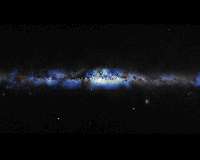
The Milky Way galaxy, a prominent feature of the night sky, has been studied in a new way by the IceCube Neutrino Observatory. For the first time, the observatory has produced an image of the Milky Way using neutrinos, which are tiny particles that act as astronomical messengers. The findings, published in the journal Science, show that the Milky Way produces fewer neutrinos compared to distant galaxies.
The IceCube Collaboration, made up of over 350 scientists from around the world, focused their search on the southern sky, where most neutrino emissions from the galactic plane are expected to be found near the center of the galaxy. However, the presence of neutrinos and other particles produced by cosmic-ray interactions with Earth’s atmosphere made it challenging to distinguish neutrinos originating from galactic sources. Additionally, neutrino production in general is relatively sparse.
To overcome these challenges, the IceCube collaborators at Drexel University developed analyses that specifically detect astrophysical neutrinos from the southern sky. Machine learning methods developed by collaborators at TU Dortmund University further improved the identification of astrophysical neutrinos, including their direction and energy reconstruction. This observation of neutrinos from the Milky Way demonstrates the value of machine learning in data analysis and event reconstruction in IceCube.
The study used a dataset of 60,000 neutrinos spanning 10 years of IceCube data. These neutrinos were compared to previously published prediction maps of where the galaxy was expected to emit neutrinos.
The observation of the galactic plane with IceCube has significant implications. An analysis by Francis Halzen and his colleagues at UW-Madison IceCube suggests that the Milky Way is 10 to 100 times dimmer in neutrinos compared to distant galaxies. This finding may provide clues to understanding the origins of extremely high-energy cosmic rays.
One implication is that our galaxy has not hosted the types of sources that produce the majority of high-energy neutrinos in the past few million years. This timeframe coincides with the last jet activity of the black hole in our own galaxy.
Future analyses by IceCube will further enhance our understanding of the particle accelerators within the Milky Way galaxy.
Denise Caldwell, director of NSF’s Physics Division, highlights the significance of technological advancements in enabling breakthroughs in science. The highly sensitive IceCube detector, coupled with new data analysis tools, has provided a new perspective on our galaxy. As these capabilities continue to improve, we can anticipate uncovering hidden features of the Milky Way that have never been seen before.


 Copyright 2023 All rights reserved.