

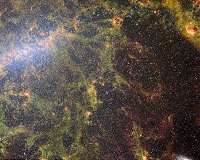
The James Webb Space Telescope has captured a stunning image of the barred spiral galaxy NGC 5068, which lies approximately 17 million light-years from Earth in the constellation Virgo. The image is part of a campaign to create an astronomical treasure trove, a repository of observations of star formation in nearby galaxies. The telescope collected images of 19 nearby star-forming galaxies which astronomers could then combine with catalogues from the Hubble Space Telescope of 10,000 star clusters, spectroscopic mapping of 20,000 star-forming emission nebulae from the Very Large Telescope (VLT), and observations of 12,000 dark, dense molecular clouds identified by the Atacama Large Millimeter/submillimeter Array (ALMA). These observations span the electromagnetic spectrum and give astronomers an unprecedented opportunity to piece together the minutiae of star formation. With its ability to peer through the gas and dust enshrouding newborn stars, Webb is the perfect telescope to explore the processes governing star formation. Stars and planetary systems are born amongst swirling clouds of gas and dust that are opaque to observations in visible light, like many from Hubble or the VLT. The keen vision at infrared wavelengths of two of Webb’s instruments – MIRI and NIRCam – allowed astronomers to see right through the gargantuan clouds of dust in NGC 5068 and capture the processes of star formation as they happened. This image combines the capabilities of these two instruments, providing a truly unique look at the composition of NGC 5068.


