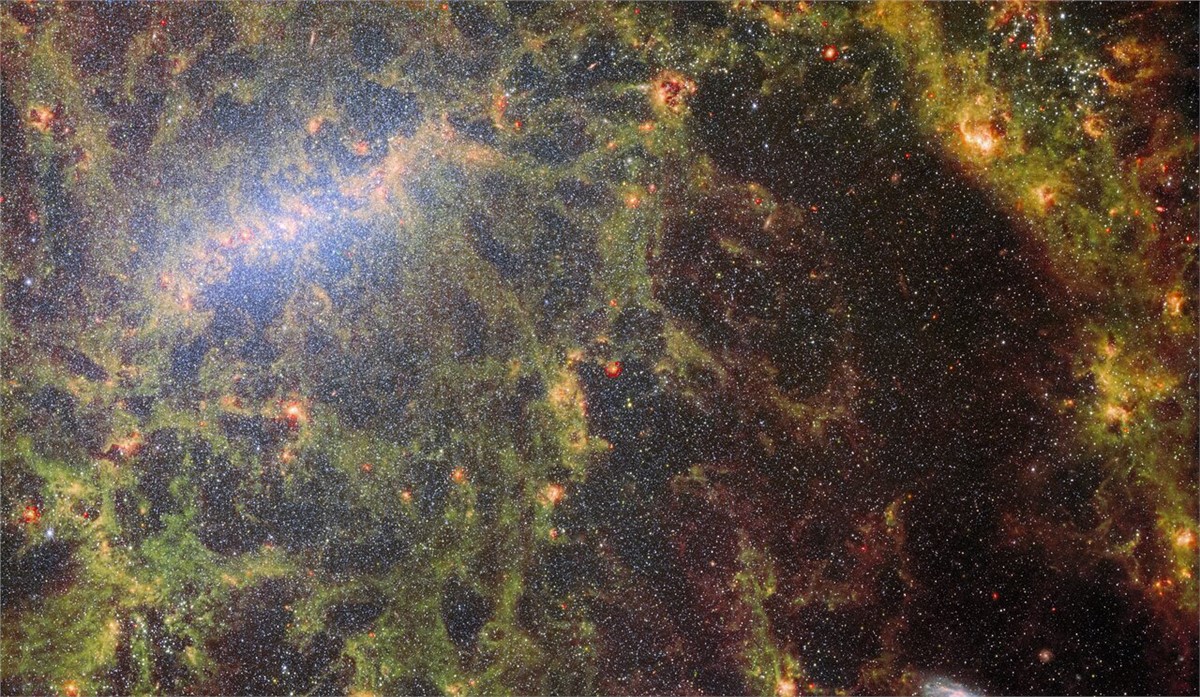
The James Webb Space Telescope has captured a stunning image of the barred spiral galaxy NGC 5068, revealing a delicate tracery of dust and bright star clusters. The image, a composite from two of Webb’s instruments, was revealed by NASA Administrator Bill Nelson during an event with students at the Copernicus Science Centre in Warsaw, Poland. NGC 5068 is located around 20 million light-years from Earth in the constellation Virgo and is part of a campaign to create an astronomical treasure trove of observations of star formation in nearby galaxies.
Astronomers are particularly interested in studying star formation as it underpins many fields in astronomy, from the physics of the tenuous plasma that lies between stars to the evolution of entire galaxies. Webb’s observations build on other studies using telescopes including the Hubble Space Telescope and ground-based observatories. By combining images from Webb with data from other telescopes, astronomers have an unprecedented opportunity to piece together the minutiae of star formation.
Webb’s ability to peer through the gas and dust enshrouding newborn stars makes it particularly well-suited to explore the processes governing star formation. Stars and planetary systems are born amongst swirling clouds of gas and dust that are opaque to visible-light observatories like Hubble or ground-based telescopes. However, the keen vision at infrared wavelengths of Webb’s instruments allowed astronomers to see right through the gargantuan clouds of dust in NGC 5068 and capture the processes of star formation as they happened.
The James Webb Space Telescope is an international program led by NASA with its partners, ESA (European Space Agency) and the Canadian Space Agency. It will solve mysteries in our solar system, look beyond to distant worlds around other stars, and probe the mysterious structures and origins of our universe and our place in it.