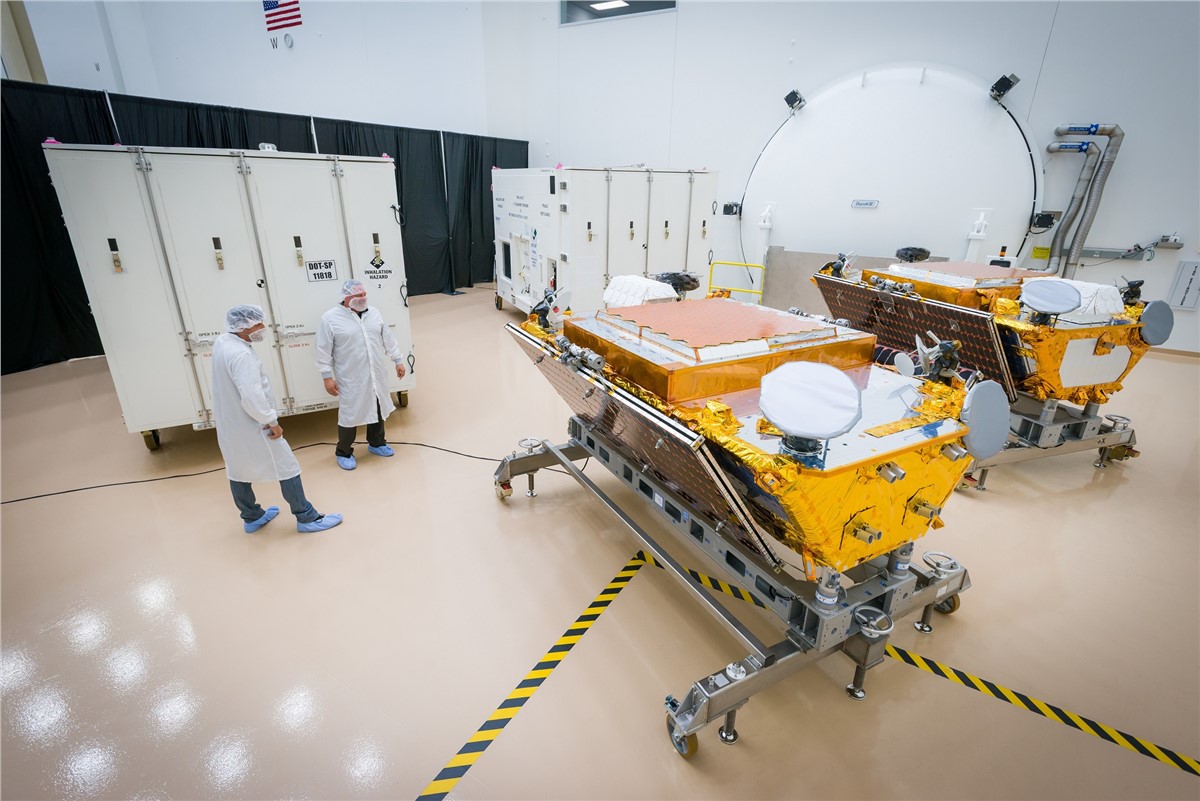
The Iridium constellation of telecommunication satellites just got a boost with the successful launch of five additional spare satellites by a SpaceX Falcon 9 rocket from the Vandenberg Space Force Base in California. Thales Alenia Space, the joint company between Thales and Leonardo, led an industrial consortium to develop and build the entire constellation. This batch of five satellites follows eight successful launches between January 2017 and January 2019, with a total of 75 Iridium satellites already deployed in low Earth orbit. The constellation operates with 66 satellites, distributed in six orbital planes of 11 satellites each, and will now be supported by 14 in-orbit spare satellites.
As prime contractor for the Iridium NEXT campaign, Thales Alenia Space was responsible for all engineering, production, procurement, and integration operations, along with the ground and in-orbit testing of the constellation’s overall performance. Northrop Grumman conducted volume production at its Gilbert, Arizona facility where the five spares were stored.
The Iridium satellite constellation is the world’s highest performance, most flexible, and most sophisticated constellation. It features global coverage with limited ground infrastructure, as each satellite is linked to the four closest satellites, in front, behind, to the right and left. This type of direct satellite access means that communications can be established at any given moment, even in the case of natural disasters or conflicts, in isolated areas, or to provide secure communications with protection against intrusion and piracy.
With a total of 80 satellites orbited in nine launches, the Iridium constellation is a remarkable feat of engineering and technology. The latest launch on May 19, 2023, saw five more satellites added to the constellation, ensuring its continued success for years to come.