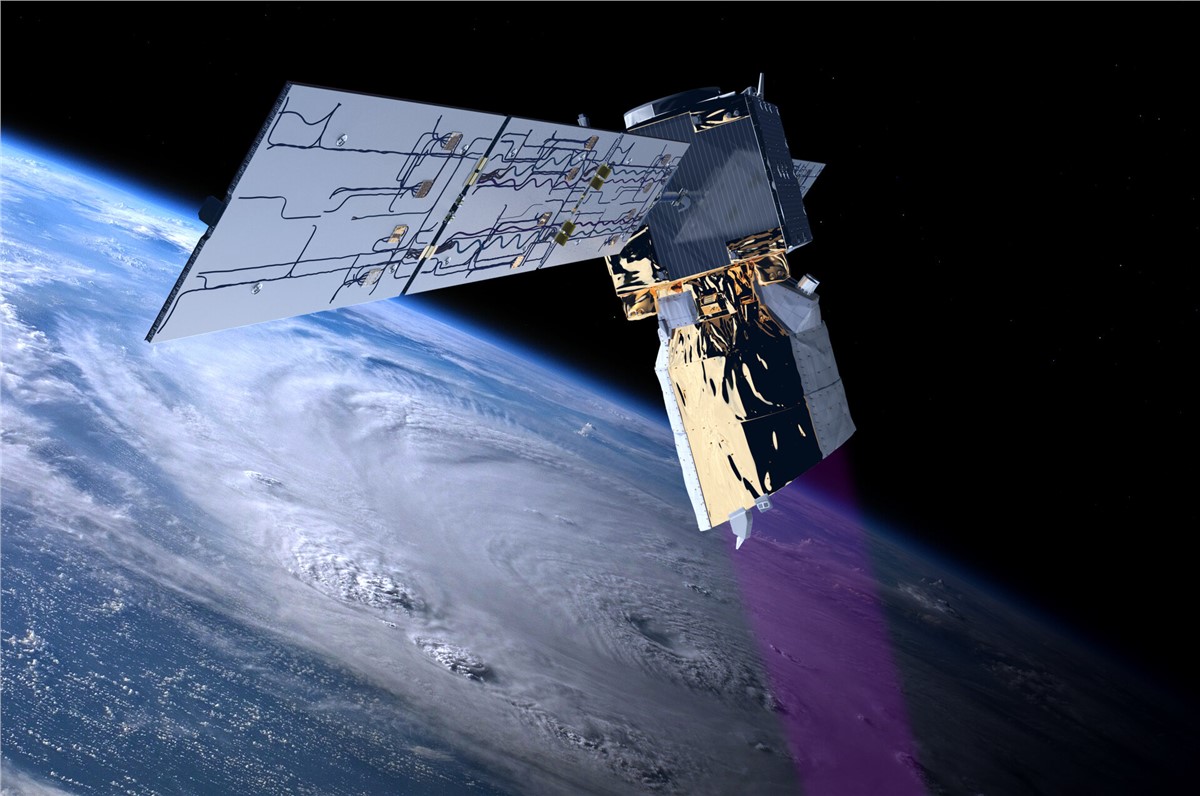
The European Space Agency’s (ESA) groundbreaking wind mission, Aeolus, is set to make its final descent back to Earth. Having exceeded its planned life in orbit by 18 months, the 1360-kg satellite is running out of fuel and will be brought back towards Earth’s atmosphere for its inevitable demise. The mission will be aimed towards the ocean to reduce the small chance of fragments causing harm should any reach Earth’s surface. This assisted reentry sets a precedent for a responsible approach to reduce the ever-increasing problem of space debris and uncontrolled reentries.
Launched in 2018, Aeolus has been hailed as one of the most successful missions ever built and flown by ESA. Its trailblazing wind-mapping laser has significantly improved weather forecasts worldwide. However, Aeolus’ fuel is almost depleted, and orbiting low at an altitude of just 320 km means it is already being caught up by Earth’s atmosphere.
Over the next few months, Aeolus will descend naturally from its current altitude of 320 km to 280 km. At this point, spacecraft operators at ESA’s mission control centre in Darmstadt, Germany, will gradually lower it to 150 km above Earth’s surface. The satellite will burn up as it descends to around 80 km.
The final date depends on how solar activity speeds up the process, but Aeolus is expected to be no more before the end of August. With the assisted reentry of Aeolus, ESA is clearing the way for future missions to continue taking the pulse of our planet. Safety is at the forefront of end-of-life activities as Earth’s orbits can only be filled with safe space debris.