

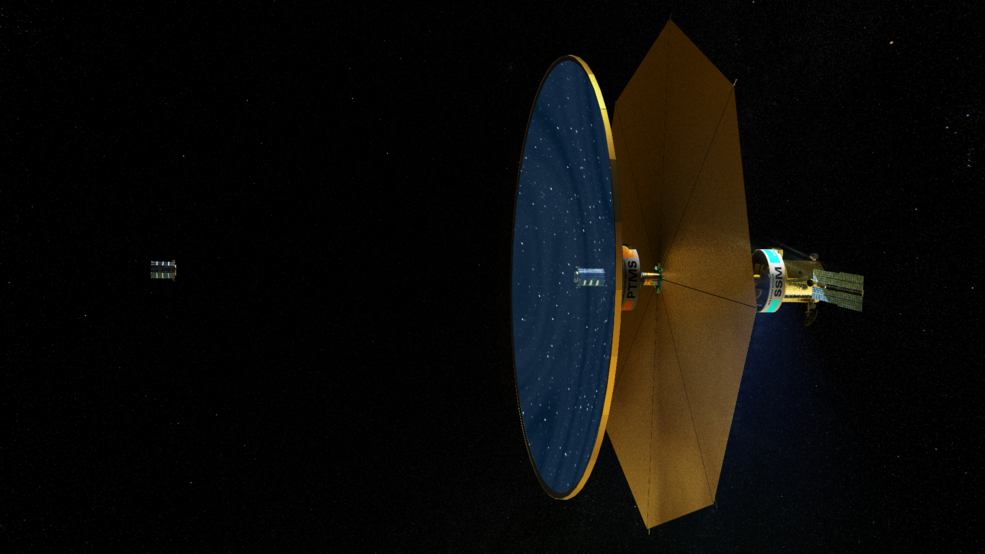
The Fluidic Telescope (FLUTE) project, led by NASA and Technion – Israel Institute of Technology, aims to create huge circular self-healing mirrors in orbit to advance the field of astronomy. Larger telescopes collect more light, allowing astronomers to see farther into space and observe distant objects in greater detail. The next-generation space observatories created by FLUTE would study high-priority astrophysics targets, including first-generation stars, early galaxies, and Earth-like exoplanets. These observatories could help answer the question of whether we are alone in the universe.
Payloads launched into space must stay within allowable size and weight limits. The aperture for the space observatory envisioned by FLUTE researchers under the current concept would be approximately 164 feet (50 meters) in diameter – half as long as a football field. Conventional technology for making optical components for telescopes involves an iterative process of sanding and polishing solid materials, such as glass or metal, to shape the precise curved surfaces of lenses and mirrors needed. Using current technologies, scaling up space telescopes to apertures larger than approximately 33 feet (10 meters) in diameter does not appear economically viable.
FLUTE’s novel cost-effective technology approach takes advantage of the way fluids naturally behave in microgravity. Liquids have an elastic-like force that holds them together at their surface, called surface tension. On Earth, when droplets of water are small enough, surface tension overcomes gravity, and they remain perfectly spherical. In space, where fluids are free-floating, even large amounts of liquids assume the most energy-efficient shape possible, a perfect sphere.
FLUTE would launch liquids to space as the raw material to make optical components in orbit. The primary mirror would form within a huge circular frame and remain in a liquid state with an extremely smooth surface for collecting light. FLUTE’s technology approach is theoretically able to scale up to very large sizes, potentially enabling telescopes with apertures measuring 10 times or even 100 times larger than telescopes to-date.
A unique feature of the liquid mirror would be its ability to self-repair if damaged in space. For instance, if a micrometeorite impacts the mirror’s surface, it would naturally heal itself within a short period of time. The FLUTE team has conducted small-scale experiments in shaping lenses from liquids in different environments, including neutral buoyancy space analog conditions in a ground laboratory and in a series of parabolic microgravity flights and aboard the International Space Station.
With the support of a NASA Innovative Advanced Concepts (NIAC) Phase I award, the team is working to analyze options for the key components of a fluid telescope observatory, further develop the mission concept, and create an initial plan for a subscale small spacecraft demonstration in low-Earth orbit. The future of space-based UV/optical/IR astronomy requires ever-larger telescopes, and FLUTE’s technology could potentially enable significant advances in astrophysics.


