

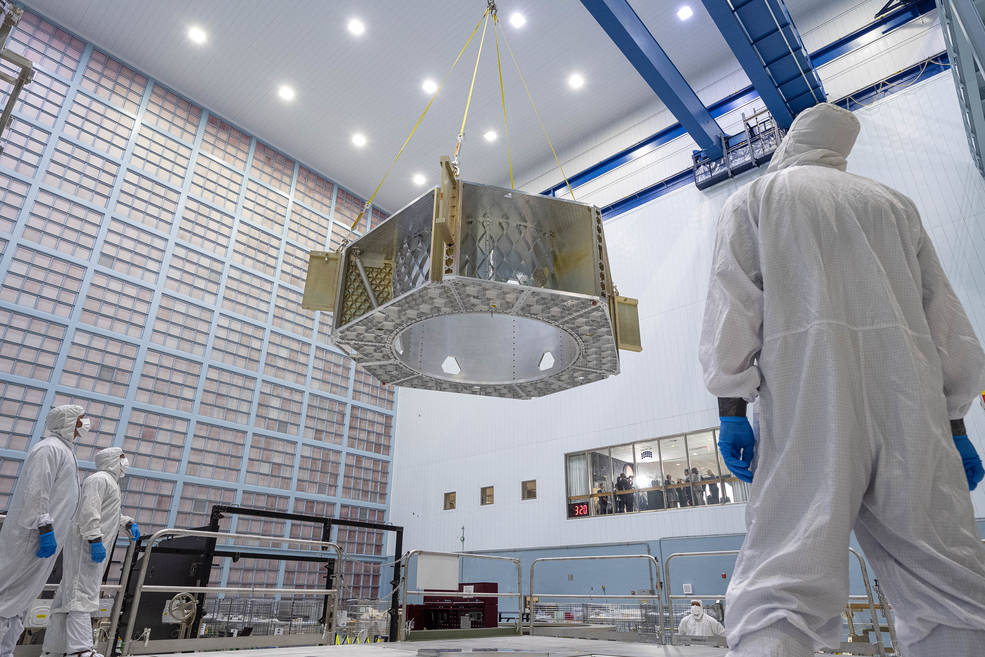
NASA’s Nancy Grace Roman Space Telescope has reached a significant milestone as the primary structure that will serve as the “bones” of the spacecraft has moved into the big clean room at NASA’s Goddard Space Flight Center in Greenbelt, Maryland. The spacecraft bus, which is Roman’s primary support element, will now be built upon this skeletal framework. The Roman Space Telescope is set to launch by May 2027 and will help unravel the secrets of dark energy and dark matter, search for and image exoplanets, and explore many topics in infrared astrophysics. The primary structure is made up of a central cylinder with a top deck that will support most of the observatory. Each of its six sides has a compartment that will house key electronics and other hardware needed to operate the observatory. Major spacecraft elements, such as its power, attitude control, and propulsion systems, will be housed within the primary structure. The high-gain antenna will be installed beneath it, and the lowermost part of the primary structure will attach the spacecraft to the rocket during launch. The structure is mainly made of a special grade of aluminum that’s strong, yet lightweight. To reduce the weight even further, most of its exterior is partly hollowed out in a triangular pattern called an isogrid. Even though it’s large – about 14 feet (4.3 meters) long, 12 feet (3.7 meters) wide, and 6.5 feet (2 meters) tall – the primary structure weighs just 3,600 pounds (1,600 kilograms). The team has applied a protective coating to protect it from the environment on Earth and provide the right temperature profile in space. The team has also performed fit checks, ensuring all the components are precisely positioned so additional parts will connect together properly. The primary structure has now been placed on the Pantheon – a large assembly platform built specifically for Roman. The team is lacing it with the harness, which serves as the spacecraft’s nervous system, and will connect the electronics together in June of 2023.


