

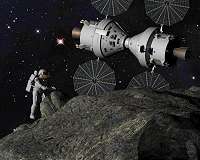
In September, NASA’s DART mission successfully shifted the orbit of the Dimorphos moonlet around its parent asteroid Didymos. Following this, the European Space Agency’s (ESA) Hera mission plans to land a pair of CubeSats on Dimorphos to gather close-up data. As scientists visualize this process, they can’t help but wonder what it would be like for human explorers to follow in the footsteps of these CubeSats.
Dimorphos is covered in large boulders, with the largest ones being around 5-7 meters across. These boulders could provide clues about the formation of Dimorphos. It is believed that Didymos, the parent asteroid, spun fast enough in the past to fling material off and collect in orbit. Didymos has a spinning top shape, with some parts of its surface appearing clear of boulders.
Moving across these boulders would require climbing and jumping rather than walking. However, caution must be exercised as jumping too fast could exceed the local escape velocity, causing an astronaut to never come down again. The ultra-low gravity environment could also trigger avalanches of rocks.
The behavior of an astronaut on Dimorphos would depend on whether the surface is hard or soft. On a softer surface, an astronaut might sink upon landing, while on a harder surface, just 6 cm per second of upward motion could send them into orbit.
Dimorphos is about 160 meters across, similar in size to the Great Pyramid of Giza. It orbits around the larger Didymos asteroid, which is about 780 meters across. DART’s impact with Dimorphos shifted its orbit and cast debris thousands of kilometers across space. Approximately 1,000 tonnes of debris were blasted away, equivalent to filling 60 train carriages.
ESA’s Hera mission, scheduled for October 2024, will gather close-up data on Dimorphos, including the size of the impact crater and the asteroid’s mineral composition and mass. Hera will also deploy two CubeSats: Juventas, which will perform the first radar probe of an asteroid’s interior, and Milani, which will carry out mineral prospecting with its hyperspectral imager. Both CubeSats will gather surface data once they land, including gravity field measurements and details of their initial bounces.
Designing for the ultra-low gravity environment of Dimorphos is a challenge. The CubeSat deployment has been designed to ensure they do not escape the asteroid’s feeble gravity. Any human astronaut would likely use spikes and crampons or a thruster unit to navigate the surface.
The surface of Dimorphos is likely to have sharp rocks that could snag a spacesuit. Additionally, an astronaut’s weight would shift by 10-20% depending on their location due to tidal forces from the Didymos parent asteroid. Navigation would also be challenging as Dimorphos may be rotating or wobbling as it orbits Didymos.
Hera’s CubeSats will first carry out their primary missions before landing on Dimorphos. Juventas’s gravimeter has been designed to operate independently of its orientation on landing, ensuring it continues working for the approximately 20-hour lifetime of its battery. Milani’s accelerometers will record the force of its bounces, providing further data on Dimorphos’ weak gravity field. Results from both CubeSats will be transmitted to Hera via inter-satellite links.
Hera is set to launch in October 2024 and will arrive at Didymos and Dimorphos just over two years later.


 Copyright 2023 All rights reserved.