

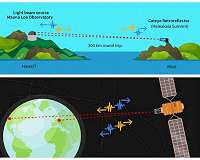
Scientists from the National Institute of Standards and Technology (NIST) have developed a method for transmitting extremely precise time signals through the air between far-flung locations at powers that are compatible with future space-based missions. The method could enable time synchronisation with femtosecond precision, 10,000 times better than existing satellite approaches. It would also allow for successful synchronisation using the bare minimum timing signal strength, which would make the system highly robust in the face of atmospheric disturbances. The new approach could allow optical clocks on opposite sides of the planet to be linked through a geosynchronous satellite, supporting the future redefinition of the SI second to an optical standard. Linking optical atomic clocks around the globe could also lead to a range of fundamental physics measurements from exploring dark matter to testing general relativity.


 Copyright 2023 All rights reserved.