

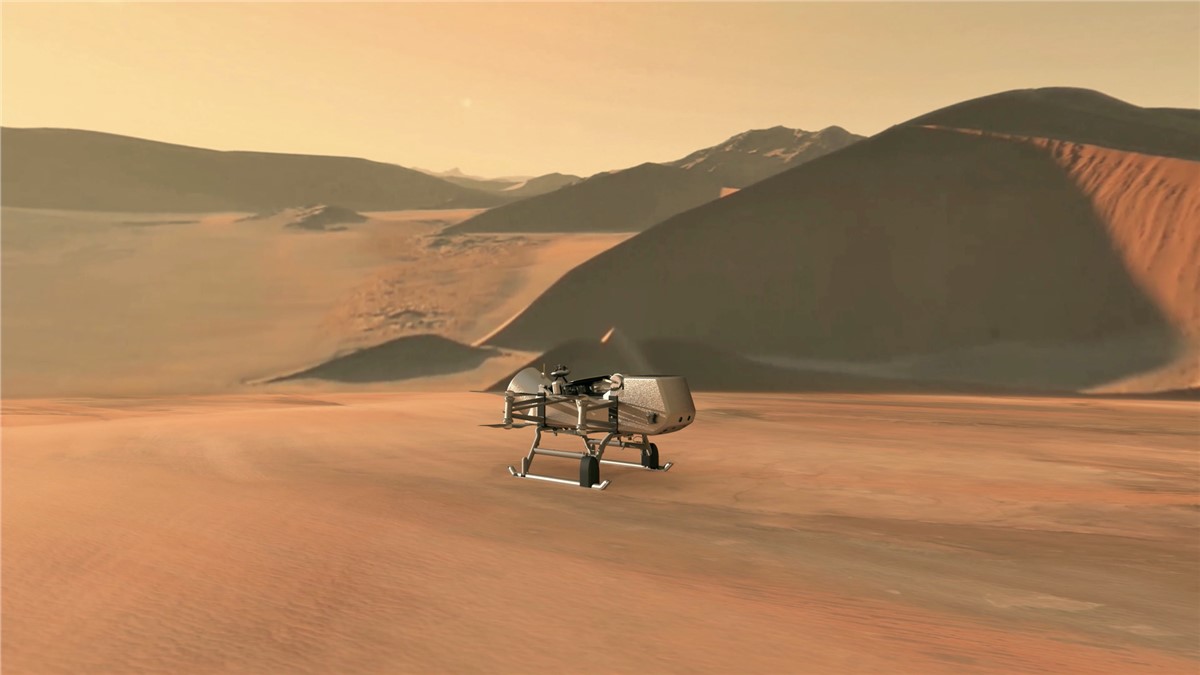
NASA is set to launch a new mission to Saturn’s moon, Titan, in 2027. The Dragonfly mission will carry an instrument called the Dragonfly Mass Spectrometer (DraMS) to study the chemistry at work on Titan and shed light on prebiotic chemistry. The mission will be led by Dr. Melissa Trainer of NASA’s Goddard Space Flight Center, who specializes in Titan and is one of the Dragonfly mission’s deputy principal investigators. The robotic rotorcraft will fly between different points of interest on Titan’s surface, allowing access to samples in environments with a variety of geologic histories. DraMS will remotely study the chemical makeup of the Titanian surface and analyze the various chemical components of a sample by separating these components down into their base molecules and passing them through sensors for identification. The instrument was developed in part by the same team at Goddard which developed the Sample Analysis at Mars (SAM) instrument suite aboard the Curiosity rover. The Dragonfly mission is managed by the Johns Hopkins Applied Physics Laboratory in Laurel, Maryland, and is the fourth mission in NASA’s New Frontiers program.




 Copyright 2023 All rights reserved.