

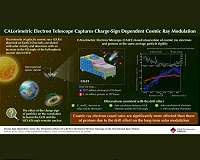
The movement of cosmic ray particles, such as electrons and protons, is influenced by the Sun’s magnetic field, causing fluctuations in the intensity of galactic cosmic rays (GCRs) reaching Earth in response to the solar cycle. During periods of low solar activity, more GCRs have been observed to reach Earth compared to periods of high solar activity. This inverse correlation between the GCR-flux and solar activity is known as “solar modulation.”
The intensity of GCRs on Earth is affected by the tilt angle of the heliospheric current sheet (HCS), a spiral surface separating the direction of oppositely directed magnetic field lines originating from the poles of the Sun. As the tilt angle of the HCS increases, the intensity of cosmic rays on Earth decreases.
According to the drift model of GCR transport in the heliosphere, the negatively charged electrons in GCRs tend to travel along the HCS to reach Earth if the magnetic field is directed away from the Sun in the northern hemisphere, and towards the Sun in the southern hemisphere. In contrast, the positively charged protons reach Earth from the heliospheric polar region, suggesting that GCR electrons are more affected by solar modulation than protons as they travel through the HCS to reach Earth.
Researchers have revealed that this anticorrelation is more prominent for electrons than for protons. The study was co-led by three researchers from Japan, Associate Professor Yosui Akaike of the Waseda Research Institute for Science and Engineering (RISE) at Waseda University, Associate Professor Shoko Miyake of the National Institute of Technology (KOSEN) at Ibaraki College, and Professor Kazuoki Munakata of Shinshu University. It also included contributions from Professor Emeritus Shoji Torii from RISE.
The researchers analyzed over 0.77 million electrons and 1.26 million protons collected in about 196 and 197 hours, respectively, over a six-year period from 2015 to 2021, which coincided with the end of solar cycle 24 and the beginning of solar cycle 25, the current solar cycle. The findings indicated that during the low activity state of the Sun towards the end of solar cycle 24, characterized by a reduction in the number of sunspots and HCS tilt angle, both electron and proton count rates were low but gradually increasing.
This trend continued with the onset of solar cycle 25, reaching its peak in electron count rate six months after the beginning of the cycle in December 2019. Thereafter, both electron and proton count rates gradually decreased as the Sun’s activity and HCS tilt angle increased. Furthermore, the results showed that the variation in the count rates of electrons was significantly higher than that of protons during this period, suggesting that electrons are more susceptible to the effects of solar modulation, as predicted by the drift model.
Analyzing GCRs can shed important light on the composition of the universe and the acceleration mechanisms of high-energy particles observed in cosmic rays. Thus, the observations made by CALET could help better understand space weather and its effects on the possibility of potential life on the Moon and other planets, like Mars.


 Copyright 2023 All rights reserved.