

Euclid Simulations: Preparing for the Unknown of Space
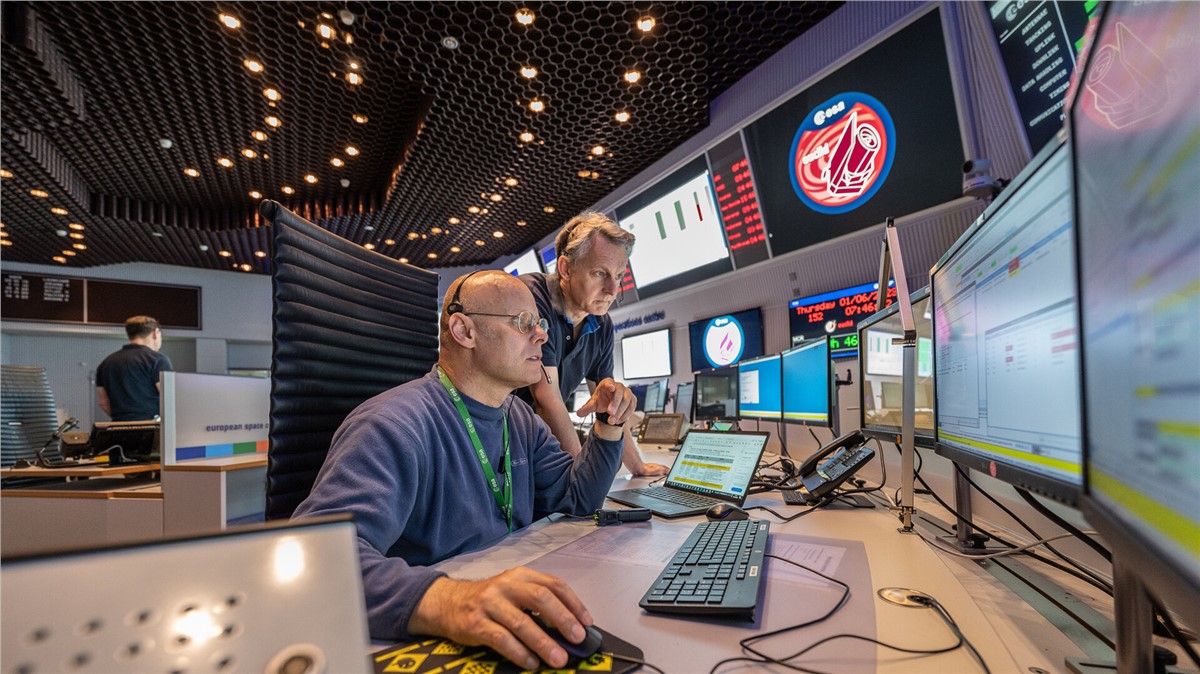
As the Euclid simulations campaign reaches its halfway point, the Main Control Room is focused on the Launch and Early Orbit Phase (LEOP) and spacecraft commissioning. These two moments are critical for any mission, as the spacecraft wakes up after launch, makes its first manoeuvres towards its target destination, and instruments are commissioned.
Joe Bush, Simulations Officer for Euclid, has spent months planning for all the ways that Euclid could fail, from problems on the spacecraft to human issues like team cohesion, confidence, and morale. On 23 March this year, Joe broke not just one, but two sets of thrusters on the Euclid spacecraft simulator. It was up to the Flight Control and Flight Dynamics Teams to decide which they could and should use.
“The double-thruster nightmare scenario underscored how successful mission operations include a wide array of experts and specialists, able to support and brainstorm with our Control Teams for the plethora of potential issues that can arise,” says Tiago Loureiro, Euclid Flight Operations Director.
Euclid’s exceptionally sensitive 1.2-metre telescope will capture light that is ten billion years old, originating from the early Universe and only now reaching us. In doing this, it will shed light on a simple question for which we still don’t have an answer: what is the Universe made of? The matter we’re made of and the light that lets us see constitutes just 5% of the Universe. The rest is dark: with dark energy making up about 70% and dark matter the remaining roughly 25%.
Euclid hopes to find out what dark matter and dark energy are, yet its instruments are only as sensitive as the operations allow them to be. Engineers at ESA’s mission control will need to protect the unshielded telescope during and after launch, ensuring no direct sunlight touches it. They will then have to calibrate and point the spacecraft with extreme precision to ensure it can clearly see.
Euclid will launch on a SpaceX Falcon 9 rocket from Cape Canaveral, Florida, USA, no earlier than July. A trajectory correction manoeuvre will nudge it to ‘Lagrange point 2’ – one of five points around the Sun and Earth where the gravitational forces between the two bodies balance out, creating gravitational ‘plateaus’ around which objects can orbit stably, without too much work to keep them in place.
From an average distance of 1.5 million km beyond Earth’s orbit, Euclid will join ESA’s Gaia telescope here at L2 and the NASA/ESA James Webb Space Telescope. It will beam a record amount of data back to Earth via ESA’s Estrack network of ground stations across the globe, precious details on the early Universe and its evolution.
Follow @esaoperations for updates on Euclid simulations and launch preparations, as teams are tested with dozens of worst-case scenarios while Euclid is on Earth, in preparation for the unknown of space.




 Copyright 2023 All rights reserved.