

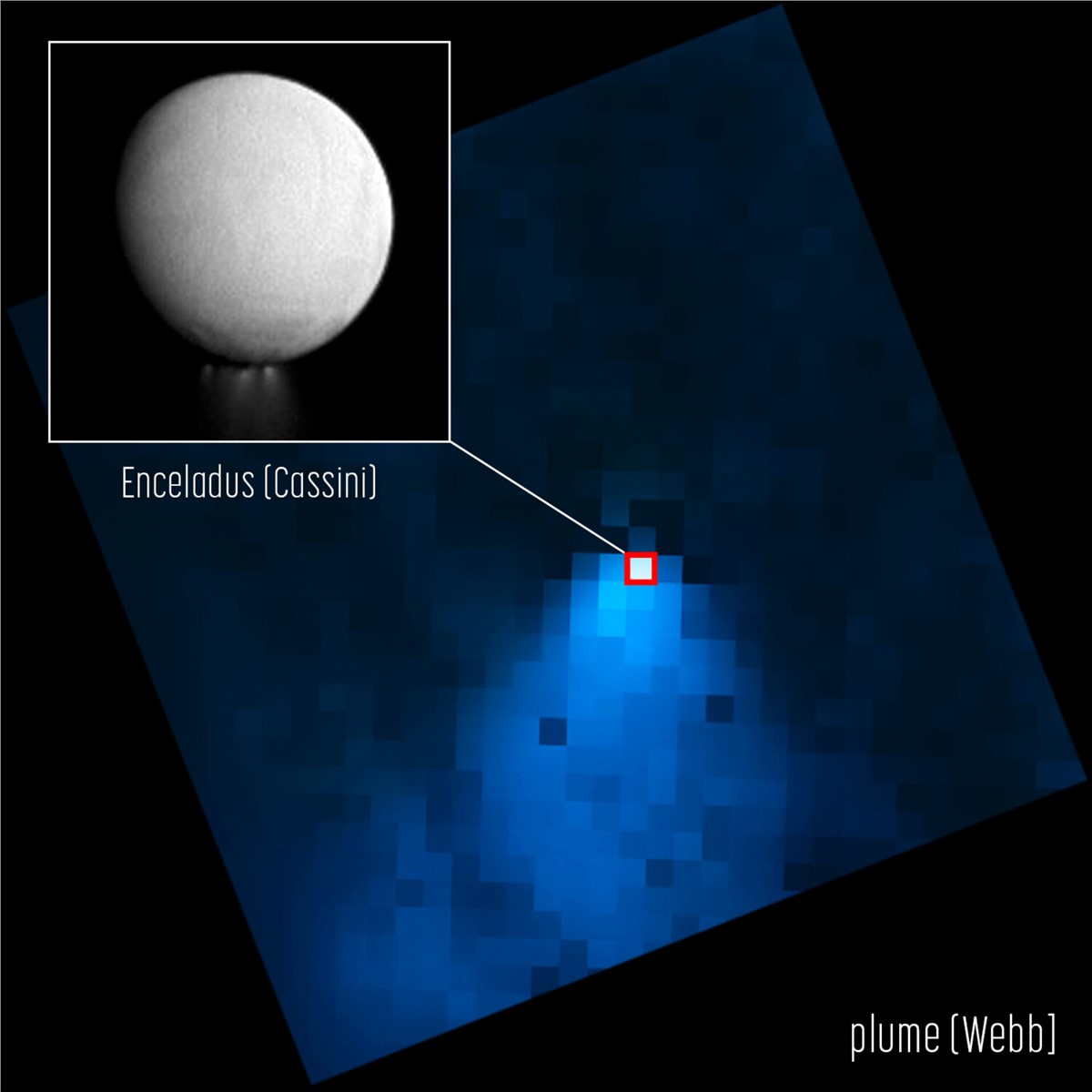
The James Webb Space Telescope has made a groundbreaking discovery, detecting a water vapour plume from Saturn’s moon Enceladus that spans over 9600 kilometres. This is the first time such water ejection has been seen over such an expansive distance, and Webb’s sensitivity has allowed scientists to directly observe how this emission feeds the water supply for the entire system of Saturn and its rings. Enceladus is one of the most exciting scientific targets in our Solar System in the search for life beyond Earth, with geyser-like volcanoes spewing jets of ice particles, water vapour, and organic chemicals out of crevices in the moon’s surface. Webb’s observations demonstrate how the moon’s water vapour plumes feed the torus, a fuzzy doughnut of water that is co-located with Saturn’s E-ring. By analysing the Webb data, astronomers have determined that roughly 30 percent of the water stays within this torus, and the other 70 percent escapes to supply the rest of the Saturnian system with water. Building on discoveries made by Webb, as well as those made by ESA’s Jupiter Icy Moons Explorer (Juice) mission, ESA is planning to get even closer to the icy moons of Jupiter and Saturn with future missions, to search for possible biosignatures.




 Copyright 2023 All rights reserved.