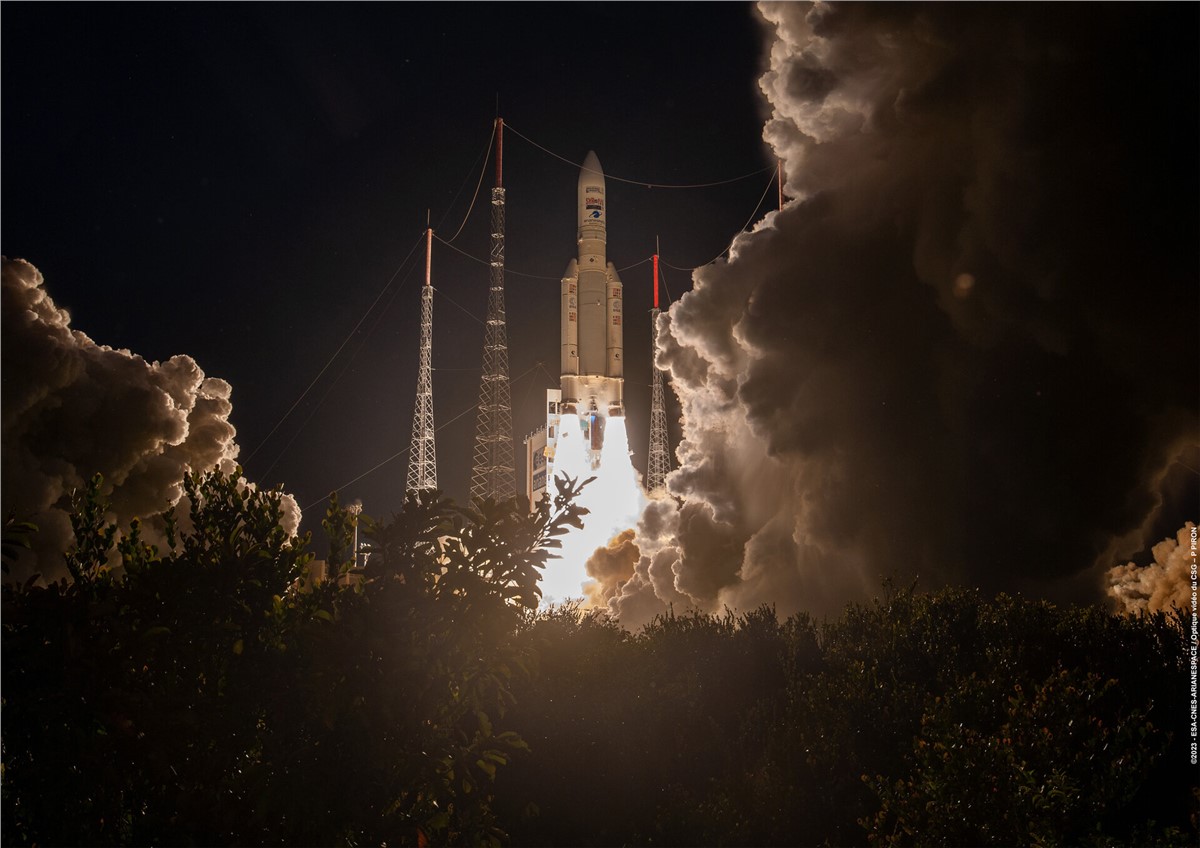
Europe bids farewell to its Ariane 5 rocket as it completes its final flight, successfully placing two payloads into their planned geostationary transfer orbits. The German aerospace agency DLR’s Heinrich Hertz experimental communications satellite and the French communications satellite Syracuse 4b were launched from Europe’s Spaceport in French Guiana. The mission lasted approximately 33 minutes from lift-off to the release of the final payload.
With a total payload mass of about 7700 kg, the Ariane 5 rocket has had an impressive career since its first launch in 1996. It has carried out numerous commercial and European institutional missions, including launching ESA’s Rosetta comet-chasing mission, a dozen of Europe’s Galileo navigation satellites, and the James Webb Space Telescope. Its second-to-last lift-off was for ESA’s Juice mission to Jupiter.
The Ariane 5 rocket has been a game-changer in terms of its capacity to carry heavy payloads into orbit. It more than doubled the mass-to-orbit capacity of its predecessor, Ariane 4, which was popular in the telecommunications industry for its ability to place large payloads into high geosynchronous orbits. The Ariane 5’s increased capacity allowed for the simultaneous launch of two large telecommunications satellites or the delivery of very large payloads into deep space.
Unlike its predecessors, Ariane 1, 2, 3, and 4, which were closely related, the Ariane 5 was developed as an all-new launch system. Its development began in 1985 with the goal of participating in the International Space Station and launching the European crewed spaceplane concept known as Hermes (which was later abandoned). The Ariane 5’s legacy includes delivering Europe’s series of five Automated Transfer Vehicle resupply spacecraft to the ISS.
The Ariane series of launch vehicles is a testament to Europe’s commitment to having an independent launch capability in the new space age. The project, initially called Europa, was a collaborative effort among several European countries. Although the Europa project was unsuccessful, it led to the creation of the European Launcher Development Organisation, which merged with the European Space Research Organisation to form ESA. This paved the way for the Ariane programme and the subsequent development of the Ariane 5 and Vega series of launch vehicles. ESA is now working on the Ariane 6, the newest addition to the Ariane family, in collaboration with its member states and industrial partners.