

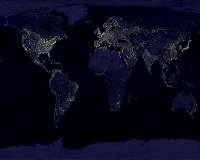
Leading experts at the National Astronomy Meeting in Cardiff are calling for action on light pollution. They argue that UK governments and local authorities need to implement policies to address the issue and restore our view of the night sky. The impacts of excessive light at night not only affect biodiversity but potentially human health as well.
Light pollution is a concern for astronomers and it is caused by various sources such as urban street lighting, poorly regulated sports grounds, commercial and industrial buildings, private housing, and entertainment venues.
One of the most noticeable effects of light pollution is skyglow, which is increasing globally by 10% each year, according to Dr. Chris Kyba of the German Research Centre for Geosciences. This means that the majority of the population is losing access to a clear view of the stars, which has been an important part of human culture and heritage.
In the UK, the charity CPRE tracks light pollution through its Star Count initiative. Participants count the number of stars they can see in the winter constellation of Orion. The results show a stark contrast between urban and rural areas in Wales, with only 3 or 4 stars visible in the brightest settings compared to 30 or more visible under dark skies. Most people in Wales (and the rest of the UK) have likely never seen the Milky Way, something that was once taken for granted by our ancestors.
There is also growing evidence of the negative impact of artificial night-light on biodiversity, particularly on nocturnal species. David Smith from the charity Buglife will be part of the panel discussion, as there are concerns that the global decline in insect populations, known as the “insect apocalypse,” may be linked to artificial light at night.
While progress at a national level has been slow, there are examples of good practices by local authorities and an increasing number of protected dark sky locations. The Eryri and Bannau Brycheiniog National Parks are among these locations. Dani Robertson, the Dark Sky Officer for the Prosiect Nos Partnership, is familiar with these parks and will contribute to the panel discussion. Innovative lighting design also plays a crucial role, and Kerem Asfuroglu, a panel member from the lighting consultancy Dark Source, works with communities to install systems that minimize light pollution.
The experts’ call for action on light pollution is supported by a recent research report titled “Citizen scientists report global rapid reductions in the visibility of stars from 2011 to 2022” by Kyba C. et al, published in Science. This report highlights the urgent need to address the issue of light pollution and its impact on our view of the night sky.


