

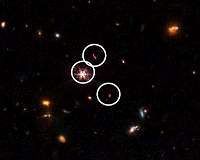
NASA’s James Webb Space Telescope has made a significant discovery in identifying the earliest strands of the cosmic web. The cosmic web is a vast interconnected structure of galaxies that formed over time as gravity drew matter together. Astronomers using the telescope have found a thread-like arrangement of 10 galaxies that existed just 830 million years after the big bang. This structure, which is 3 million light-years long, is anchored by a luminous quasar, which is a galaxy with an active, supermassive black hole at its core. The team believes that this filament will eventually evolve into a massive cluster of galaxies, similar to the well-known Coma Cluster in the nearby universe.
The discovery was made as part of the ASPIRE project, which aims to study the cosmic environments of the earliest black holes. The project will observe 25 quasars that existed within the first billion years after the big bang, known as the Epoch of Reionization. The team was surprised by the length and narrowness of the filament they discovered, as it is one of the earliest filamentary structures associated with a distant quasar.
In addition to identifying the cosmic web, the study also investigated the properties of eight quasars in the young universe. The team confirmed that their central black holes range in mass from 600 million to 2 billion times the mass of our Sun. This raises questions about how these black holes could grow so large so quickly. To form supermassive black holes in such a short time, two criteria must be satisfied: starting from a massive “seed” black hole and accreting a million times more matter at the maximum possible rate for its entire lifetime.
The observations made by the Webb telescope also provided evidence of how early supermassive black holes potentially regulate the formation of stars in their galaxies. As supermassive black holes accrete matter, they can also power outflows of material, which can have a significant impact on the formation of stars. The scale of these winds is related to the structure of the quasar, and the observations made by the Webb telescope show that such winds existed in the early universe.
These findings were published in two papers in The Astrophysical Journal Letters on June 29. The discoveries made by the Webb telescope provide important insights into the formation and evolution of the cosmic web, as well as the growth and impact of supermassive black holes in the early universe.


