

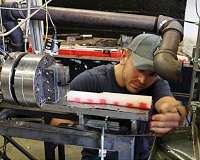
Virginia Tech has been awarded $7.5 million by the Department of Defense (DOD) to lead a multi-university research project on the combustion of polymeric solid fuels. The project, which will span three years, aims to advance the understanding of how polymeric solid fuels burn and develop computational models to predict their behavior under various flow conditions. The research will bring together leading researchers and engineers from Penn State, Georgia Tech, Iowa State University, Stanford University, University of California Riverside, and North Carolina State University.
Solid fuel sources have advantages over liquid propellants in terms of simplicity, lower cost, and ease of storage and handling, making them ideal for military and space applications. However, there are still fundamental gaps in the chemistry and physics of polymeric solid fuel combustion that need to be addressed. The research will provide valuable data relevant to the U.S. Navy and its development of high-speed and hypersonic vehicles.
The primary investigator leading the research effort is Gregory Young, an associate professor at Virginia Tech’s Kevin T. Crofton Department of Aerospace and Ocean Engineering. Young is a leading expert in energetic materials, combustion, and propulsion. The research will focus on unraveling the complex combustion behavior of solid fuels under different conditions, such as heat transfer, pyrolysis, condensed phase chemistry, mixing, and gas phase chemistry.
The research team will use a multidisciplinary approach involving experimental, theoretical, and numerical techniques to develop a unified model for solid fuel combustion. Large-scale experimentation will be conducted at research facilities at Virginia Tech and Penn State. The data derived from this study will enhance scientists’ and engineers’ understanding of physicochemical processes in solid fuel combustion and enable them to make predictions for revolutionary solid fuel sources.
To expand the educational impact of the research, students from different institutions will be cross-trained in various laboratories. This will provide them with hands-on experience and foster collaboration among students from different universities. The research will also involve collaborations with government labs, such as the U.S. Naval Research Laboratory and the Air Force Research Laboratory. The goal is to train the next generation of scientists and engineers and provide them with internship opportunities at DOD laboratories and facilities.
Overall, this research project aims to advance the understanding of polymeric solid fuel combustion and develop models that can be used to develop revolutionary solid fuels for extreme conditions. The knowledge gained from this research will also improve future studies on fundamental and applied combustion.


 Copyright 2023 All rights reserved.