

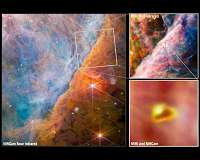
NASA’s James Webb Space Telescope has detected a new carbon compound in space for the first time. The molecule, called methyl cation (CH3+), is important because it aids the formation of more complex carbon-based molecules. The molecule was found in a young star system called d203-506, which is located about 1,350 light-years away in the Orion Nebula. Carbon compounds form the foundations of all known life, and as such are particularly interesting to scientists working to understand both how life developed on Earth, and how it could potentially develop elsewhere in our universe. The study of interstellar organic (carbon-containing) chemistry is an area of keen fascination to many astronomers. The unique capabilities of Webb made it an ideal observatory to search for this crucial molecule. While the star in d203-506 is a small red dwarf, the system is bombarded by strong ultraviolet (UV) light from nearby hot, young, massive stars. Scientists believe that most planet-forming disks go through a period of such intense UV radiation, since stars tend to form in groups that often include massive, UV-producing stars. The team predicts that UV radiation might actually provide the necessary source of energy for CH3+ to form in the first place. Once formed, it then promotes additional chemical reactions to build more complex carbon molecules.


