

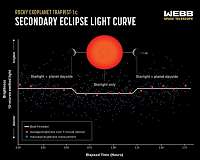
An international team of researchers has used NASA’s James Webb Space Telescope to study the rocky exoplanet TRAPPIST-1 c and calculate the amount of heat energy coming from it. The result suggests that the planet’s atmosphere, if it exists at all, is extremely thin. TRAPPIST-1 c is now the coolest rocky exoplanet ever characterized based on thermal emission, with a dayside temperature of roughly 380 kelvins (about 225 degrees Fahrenheit). The precision necessary for these measurements further demonstrates Webb’s utility in characterizing rocky exoplanets similar in size and temperature to those in our own solar system. TRAPPIST-1 c is one of seven rocky planets orbiting an ultracool red dwarf star (or M dwarf) 40 light-years from Earth. During the first billion years of their lives, M dwarfs emit bright X-ray and ultraviolet radiation that can easily strip away a young planetary atmosphere. In addition, there may or may not have been enough water, carbon dioxide, and other volatiles available to make substantial atmospheres when the planets formed. The absence of a thick atmosphere suggests that the planet may have formed with relatively little water. If the cooler, more temperate TRAPPIST-1 planets formed under similar conditions, they too may have started with little of the water and other components necessary to make a planet habitable.


