

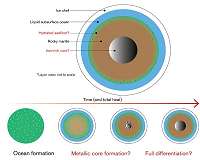
A recent study by Arizona State University scientists Kevin Trinh, Carver Bierson and Joe O’Rourke of the School of Earth and Space Exploration has revealed that Jupiter’s moon, Europa, may have had a slow evolution. Europa is slightly smaller than Earth’s moon and is believed to be made of four layers: an ice shell, salt water ocean, rocky mantle and metallic core. The moon’s ocean touches the rocky seafloor, which may allow for rock-water chemistry favourable for life. The ASU study investigated the consequences of Europa forming with low initial temperatures, using computer code that Trinh wrote. Their findings show that if Europa indeed formed from hydrated rocks, then enough of Europa’s interior would have gotten hot enough to release water directly from the hydrated rocks to form the ocean and ice shell. The existence of a metallic core is deeply tied to Europa’s internal heat, which may also be used to drive seafloor volcanism and contribute to a habitable seafloor environment. However, it is unclear whether Europa generated enough heat to form such a core. The study implies that there may be limited hydrothermal activity and seafloor volcanism at Europa, which may hinder habitability. NASA plans to launch a spacecraft called Europa Clipper in October 2024, which should arrive at Europa in April 2030. With the recent work by Trinh, Bierson and O’Rourke, scientists will be better equipped to interpret incoming data from Europa Clipper, whose main objective is to evaluate Jupiter’s icy moon Europa for the potential conditions to host life.


