

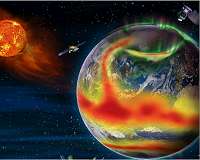
A team of international scientists led by Dr Nigel Meredith of the British Antarctic Survey (BAS) has analysed 20 years of data from a US GPS satellite to determine the 1 in 10, 1 in 50, and 1 in 100-year event levels for high-energy ‘relativistic’ electrons. These electrons, also known as “killer” electrons, are a major source of radiation damage to satellites and understanding their patterns of activity is crucial. During geomagnetic storms, the number of killer electrons in the outer radiation belt can increase by orders of magnitude and become a significant space weather hazard.
The findings are important for satellite operators, manufacturers, insurers, and governments as society is increasingly reliant on satellites for communication, navigation, Earth observation and defence. As of April 2022, there were 5,465 operational satellites in Earth orbit, and most are exposed to energetic electrons for at least some of their orbit. In 2021, the overall global space economy generated revenues of $386 billion, an increase of four percent compared to the previous year.
The difference between the 1 in 10 year and 1 in 100-year event varies depending on the energy of the electrons and the distance from Earth. These differences are largest at the highest energies furthest from the planet, varying between a factor of 3 and 10 for some of the highest electron energies over 35,000 km from the Earth’s surface. Such substantial increases could pose a significant additional risk to satellites operating in this region.
Severe space weather was added to the UK National Risk Register of Civil Emergencies in 2011. The impacts of space weather on satellites can range from momentary interruptions of service to total loss of capabilities. In 2003 a major storm caused 47 satellites to experience anomalies, over 10 to be out of action for more than a day and one was a complete loss. The findings are essential for satellite insurers to help them ensure satellite operators are doing all they can to reduce risk and to evaluate realistic disaster scenarios.


