

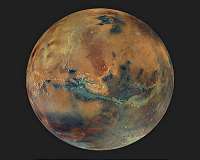
The Mars Express spacecraft, the first European mission to explore another planet in the Solar System, launched on a Soyuz launch vehicle from the Baikonur Cosmodrome in Kazakhstan on June 2, 2003. The High Resolution Stereo Camera (HRSC), developed at the German Aerospace Center (DLR) and operated by the DLR Institute of Planetary Research, is one of seven experiments on board. The mission was originally only supposed to last one martian year, but the success of the instruments has prompted the European Space Agency (ESA) to extend the mission again and again, most recently until the end of 2026. To mark the 20th anniversary of the launch, a celebration will take place today, June 2, at ESA’s European Space Operations Centre (ESOC) in Darmstadt at the end of a scientific and technical symposium.
The HRSC normally photographs Mars from an altitude of approximately 300 kilometers to acquire its usual surface images. The resulting views of the martian surface have a spatial resolution of up to 12.5 meters per pixel and cover areas approximately 50 kilometers wide. Thanks to its four color channels (red, green, blue, infrared) and five panchromatic nadir, stereo and photometric channels, the stereo camera can visualize Mars in three dimensions and also in color.
For the global data product presented here, however, 90 individual images were used, taken from higher altitudes (between roughly 4000 and 10,000 kilometers) above the martian surface and thus covering areas approximately 2500 kilometers wide on average and at lower spatial resolution (between 200 and 800 meters per pixel). Such large-scale images are typically acquired to observe weather patterns on Mars. But if no clouds or other atmospheric phenomena are visible on the images, they are excellent for creating global views of the martian surface.
The global view of Mars shown here has a spatial resolution of two kilometers per pixel, although higher resolution global HRSC mosaics are possible and are already in development. Since its commissioning in January 2004, the HRSC has imaged almost the entire planet – an area of almost 150 million square kilometers – at image resolutions of between 50 and 20 meters per pixel. Many areas have been imaged at the instrument’s highest possible resolution of 12.5 meters per pixel. This contrast-enhanced mosaic, with a resolution one hundredth of this maximum, reveals an unprecedented variety and detail of colors across the martian surface, which also provide information about its composition.
It is well known that most of Mars is reddish in color, due to the high amount of oxidized iron in the dust on its surface, earning it the nickname the ‘Red Planet’. But it is also immediately noticeable that a considerable region of Mars is rather dark, appearing bluish in color. These regions represent greyish-blackish-bluish sands, which are volcanic in origin and form large, dark sand layers on Mars. They were primarily piled up by the wind to form imposing sand dunes or enormous dune fields on the floor of impact craters. These unweathered sands consist of dark, basaltic minerals, of which volcanic lava on Earth is also composed.
Volcanic material on Mars that has been weathered by water, on the other hand, tends to take on lighter shades over time. For example, clay and sulfate minerals – the two most common minerals on Mars formed through the contact of cooled lava and water – appear particularly bright on such color composites and are relatively easy to recognize on closer inspection.
One of the largest clay mineral deposits on Mars, located around the former outflow channel Mawrth Vallis, attests to the former long-term presence of water on Mars, with the original, basaltic source rock having weathered to clay minerals at neutral pH and relatively warm temperatures.
Large deposits of similarly light-colored sulfate minerals such as gypsum (calcium sulfate) or kieserite (magnesium sulfate) can be seen in this mosaic within the Valles Marineris canyon system – a vast rift valley over 4000 kilometers long and stretching along the martian equator. Here, they are covered by a thin veneer of dark sand and thus only reveal their impressive color variations on closer inspection made using the HRSC. Sulfate minerals indicate environmental conditions at low, acidic pH values, which are less accommodating to life.
The faint, bright, and light blue areas depict clouds in the atmosphere. Images containing clouds could not be entirely avoided in the creation of this first version of the global Mars mosaic. The depths of Valles Marineris are also overlaid with atmospheric phenomena. However, these represent fog and haze, which often form within depressions at certain times of the day and year.


