

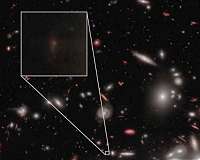
Astrophysicists from UCLA have confirmed the existence of the faintest galaxy ever seen in the early universe. The galaxy, named JD1, is one of the most distant galaxies identified to date, and is typical of the galaxies that burned through the fog of hydrogen atoms left over from the Big Bang, allowing light to shine through the universe and shape it into what exists today. The first billion years of the universe’s life were a crucial period in its evolution. After the Big Bang, approximately 13.8 billion years ago, the universe expanded and cooled sufficiently for hydrogen atoms to form. Hydrogen atoms absorb ultraviolet photons from young stars; however, until the birth of the first stars and galaxies, the universe became dark and entered a period known as the cosmic dark ages. The appearance of the first stars and galaxies a few hundred million years later bathed the universe in energetic ultraviolet light which began burning, or ionizing, the hydrogen fog. That, in turn, enabled photons to travel through space, rendering the universe transparent. Determining the types of galaxies that dominated that era – dubbed the Epoch of Reionization – is a major goal in astronomy today, but until the development of the Webb telescope, scientists lacked the sensitive infrared instruments required to study the first generation of galaxies.


 Copyright 2023 All rights reserved.