

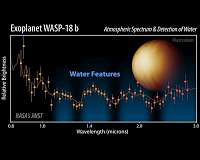
Astronomers have used the Canadian NIRISS instrument on the James Webb Space Telescope (JWST) to study WASP-18 b, an ultra-hot gas giant exoplanet located 400 light-years away. The team identified water vapour in the planet’s atmosphere and made a temperature map of the planet as it passed behind its star. The map showed a huge change in temperature, up to 1,000 degrees Celsius, from the hottest point facing the star to the terminator where the day and night sides of the tidally-locked planet meet in permanent twilight. The team also found that there was a lack of east-west winds on the planet’s dayside, which is best matched by models with atmospheric drag. One possible explanation is that this planet has a strong magnetic field. The NIRISS instrument was used for about six hours to observe WASP-18 b as part of the Transiting Exoplanet Community Early Release Science Program.


 Copyright 2023 All rights reserved.