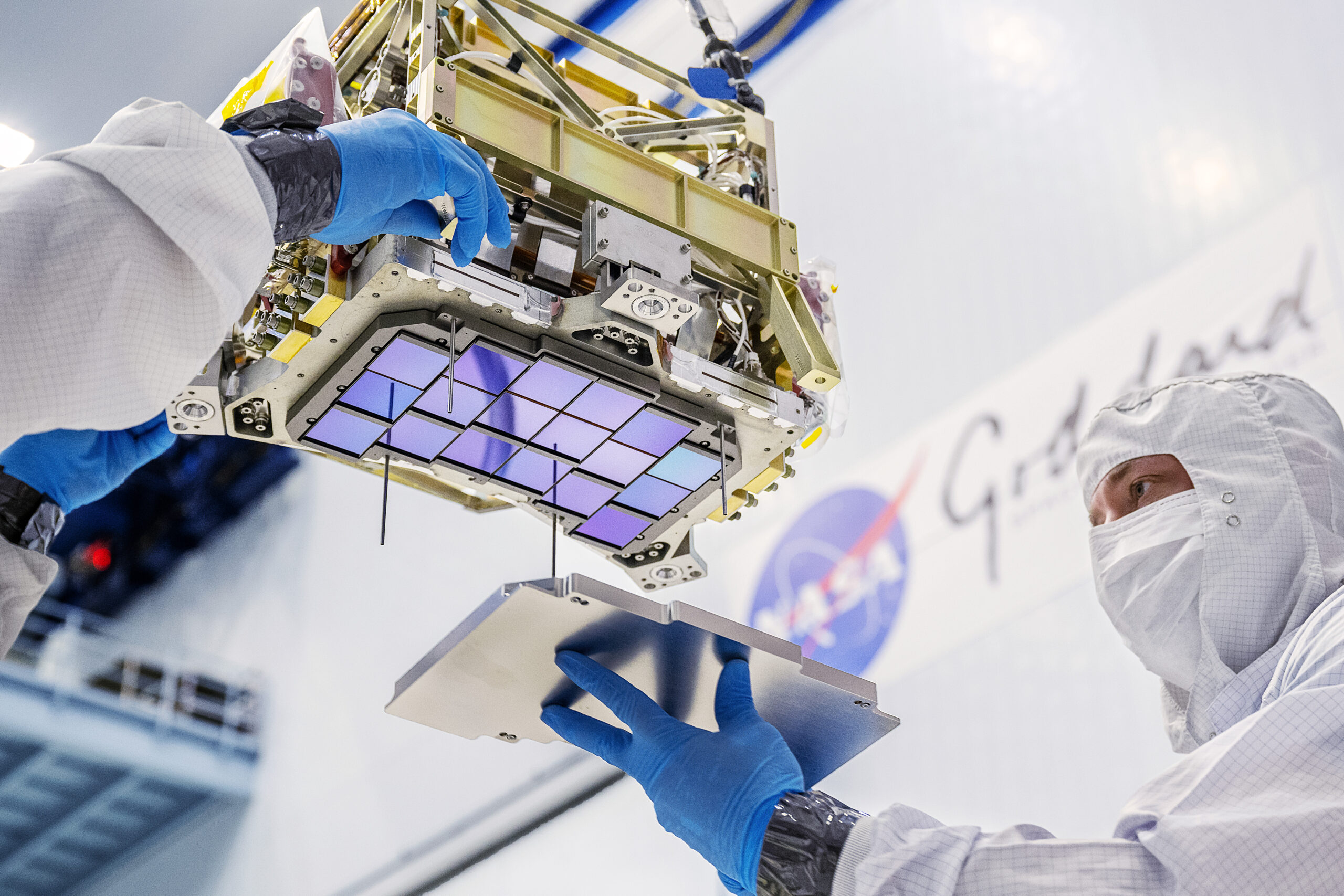
NASA’s upcoming Nancy Grace Roman Space Telescope is set to launch in May 2027, and the heart of the telescope, the Focal Plane System (FPS), has just been delivered to Ball Aerospace in Boulder, Colorado. The FPS is a large detector array and its associated electronics, which will serve as the core of Roman’s camera. With 18 detectors, each containing 16.8 million pixels, the FPS is one of the largest focal plane arrays ever flown onboard a space-based observatory.
The FPS was developed by engineers at NASA’s Goddard Space Flight Center in Greenbelt, Maryland, and Teledyne Scientific & Imaging in Camarillo, California. Once installed in the spacecraft’s Wide Field Instrument (WFI), technicians will continue the build by integrating radiators to ensure optimal performance of the detectors.
“For optimal performance, the detectors must be operated at minus 288 degrees Fahrenheit, or minus 178 degrees Celsius,” said Greg Mosby, a research astrophysicist and Roman detector scientist at Goddard. “Roman’s detectors are so sensitive that nearby components in the Wide Field Instrument must also be cooled, otherwise their heat would saturate the detectors, effectively blinding the observatory.”
The WFI is expected to return to Goddard in spring of 2024 for integration into the rest of the observatory. Once launched, astronomers will use the system to gather high-resolution images to help unravel the secrets of dark energy and dark matter, discover exoplanets, and explore many topics in infrared astrophysics. Mary Walker, the Roman WFI manager at Goddard, said, “Its creation is the product of many years of innovation from a very dedicated team – one that is eagerly anticipating the incredible science Roman will yield.”