

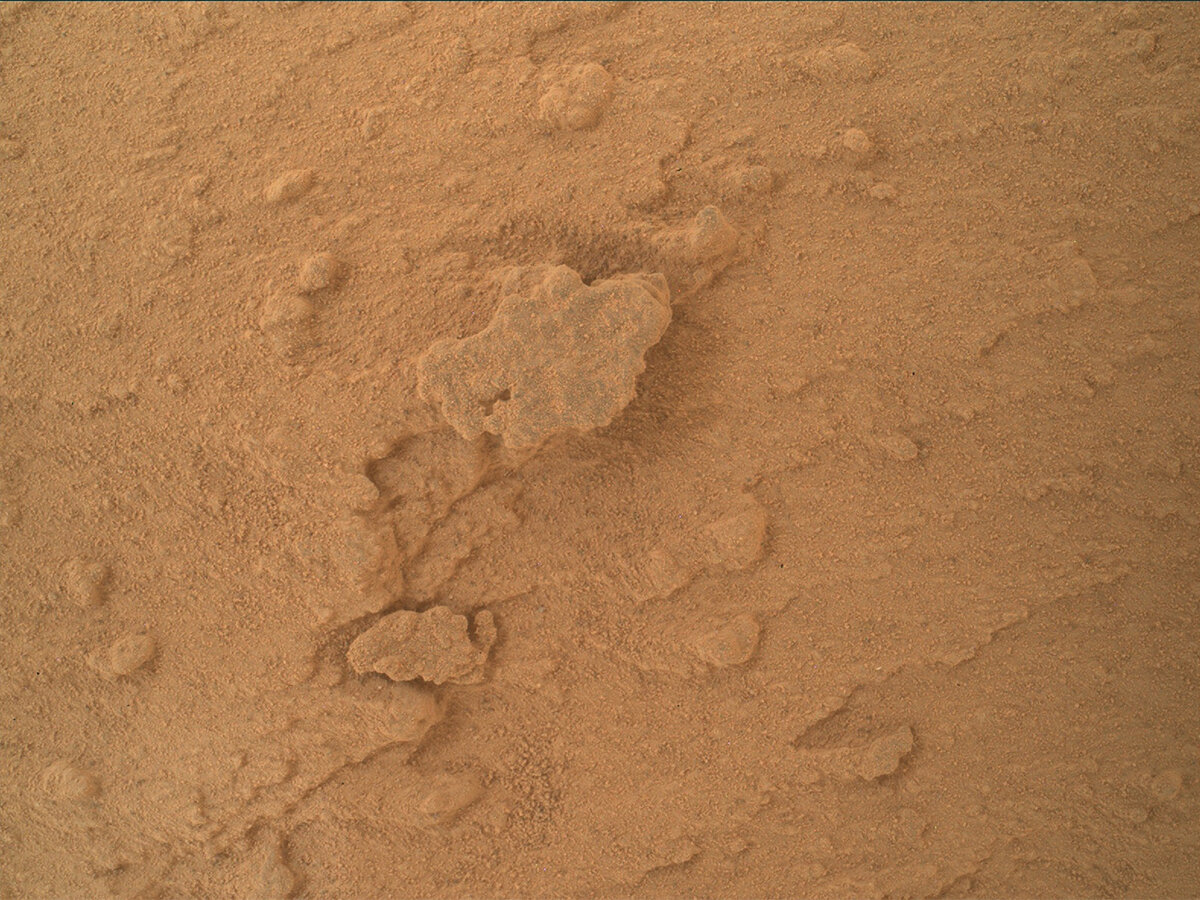
On May 5th, 2023, the Curiosity rover continued its investigation of the “Ubajara” potential drill site on Mars. The rover planners conducted a “preload” test to determine the stability and safety of the rock before drilling. MAHLI, the rover’s camera, took two documentation images after the test to ensure that there were no changes.
In addition to investigating the Ubajara site, Curiosity also examined a patch of darker material at “Ilha Grande” and some adjacent bedrock at “Ilha Grande offset” for comparison. MAHLI also imaged the target “Bwesse Kiiki,” which was analyzed by ChemCam’s LIBS instrument on sol 3818.
ChemCam analyzed nodular bedrock just beyond the Ubajara bedrock block at “Carajas” and took a long-distance image (“LD RMI”) of Gediz Vallis, a large ridge feature that has been high on the rover’s “dream list” of places to go in Gale since before landing. The ChemCam RMI focused on an area of large stones and boulders that were identified in previous images.
Mastcam acquired a “9×3 mosaic” of fractured light-toned rocks ahead of the rover’s future drive direction. These rocks are close to some small impact craters, so the team is interested in examining the fractures to see if they are related to the craters.
ENV and Mastcam monitored dust with a “crater rim image” and two tau measurements to quantify the abundance of dust in the atmosphere. ECAM added several images to characterize active environmental conditions in Gale, looking at clouds and searching for dust devils. DAN and REMS rounded out the environmental monitoring, measuring hydrogen concentrations and temperatures, respectively.


