

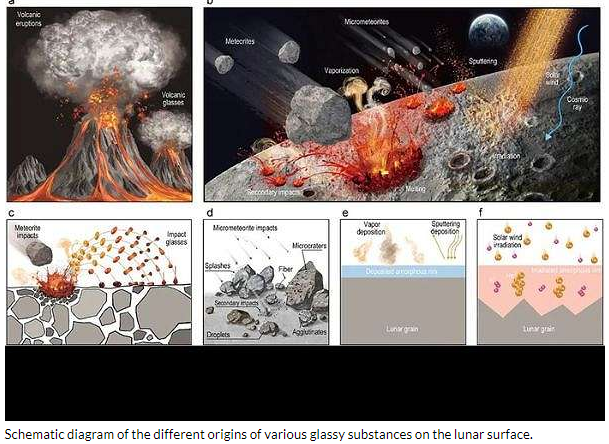
China’s Chang’e-5 mission has provided valuable samples for studying extraterrestrial glass substances on the moon’s surface. Lunar glass can remain stable for hundreds of millions of years, preserving ancient lunar materials and environmental information, similar to how amber does on Earth. A team led by Academician Wang Weihua from the Institute of Physics of the Chinese Academy of Sciences recently conducted systematic material science research on the Chang’e-5 lunar soil samples, focusing on glass. They discovered various types and origins of lunar glass materials, constructing a classification catalog of lunar soil glass/amorphous phases. The research team discovered that various forms of glass on the moon’s surface originate from multiple transformation paths involving solids, liquids, and gases. Frequent meteorite and micrometeorite impacts on the lunar surface cause minerals to melt and rapidly cool, producing a range of glass substances. These include rotating-shaped glass beads (spherical, ellipsoidal, dumbbell-shaped), cement with pore structures, and fluid forms of sputtering. The widespread vapor-deposited amorphous layer identified in this study resolves the current debate about the presence of a sedimentary layer on the Chang’e-5 lunar soil grains’ surface. Glass materials originating from melt cooling, vapor deposition, and ion irradiation reveal the interaction between the lunar surface and space environment, significantly contributing to understanding the formation and evolution of lunar regolith.


