

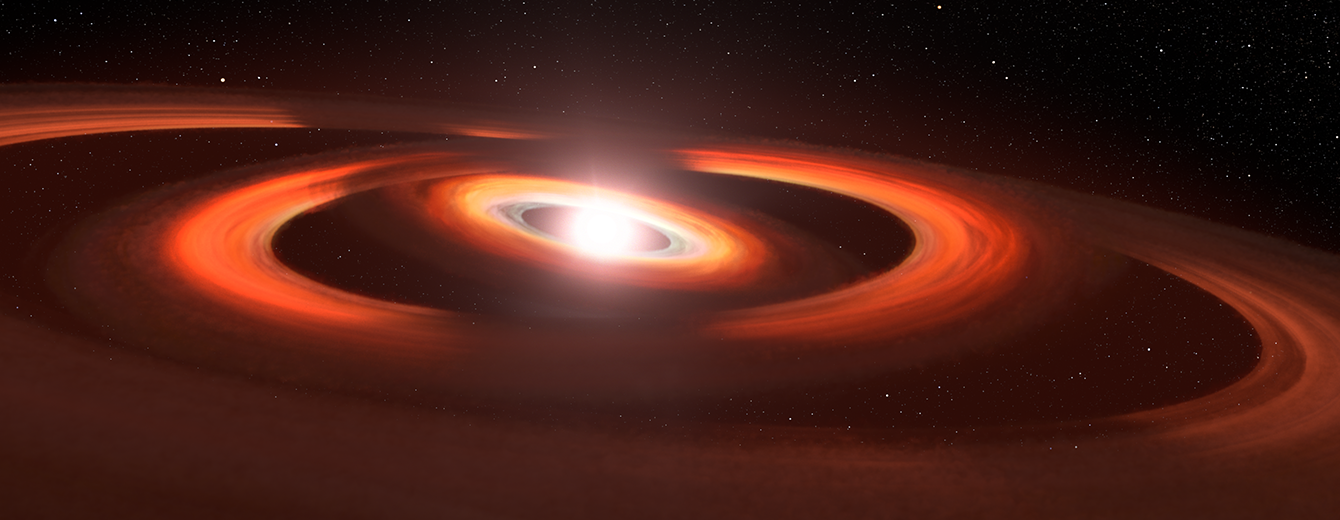
In 2017, astronomers observed a shadow sweeping across a disk of dust and gas surrounding the young star TW Hydrae. The shadow was cast by an inner disk of dust and gas that is slightly tilted to the plane of the outer disk. The system is tilted face-on to Earth, giving astronomers a bird’s-eye view of the disk as the shadow sweeps around the disk like a hand moving around a clock. Astronomers used Hubble to find a second shadow emerging from yet another inner disk, that is tilted to the two outer disks. The disks are proxies for unseen planets around the star. Each planet is gravitationally pulling on material near the star and warping what would have been a perfectly flat, pancake-shaped disk if no planets were present.
The young star TW Hydrae is less than 10 million years old and resides about 200 light-years away. In its infancy, our solar system may have resembled the TW Hydrae system, some 4.6 billion years ago. Because the TW Hydrae system is tilted nearly face-on to our view from Earth, it is an optimum target for getting a bull’s-eye-view of a planetary construction yard.
The second shadow was discovered in observations obtained on June 6, 2021, as part of a multi-year program designed to track the shadows in circumstellar disks. The best solution the team came up with is that there are two misaligned disks casting shadows. They were so close to each other in the earlier observation they were missed. Over time they’ve now separated and split into two shadows.
The simplest explanation is that the misaligned disks are likely caused by the gravitational pull of two planets in slightly different orbital planes. Hubble is piecing together a holistic view of the architecture of the system. The suspected planets are located in a region roughly the distance of Jupiter from our Sun. And, the shadows complete one rotation around the star about every 15 years – the orbital period that would be expected at that distance from the star.
Also, these two inner disks are inclined about five to seven degrees relative to the plane of the outer disk. This is comparable to the range of orbital inclinations inside our solar system. The outer disk that the shadows are falling on may extend as far as several times the radius of our solar system’s Kuiper belt. This larger disk has a curious gap at twice Pluto’s average distance from the Sun. This might be evidence for a third planet in the system.
Any inner planets would be difficult to detect because their light would be lost in the glare of the star. Also, dust in the system would dim their reflected light. ESA’s Gaia space observatory may be able to measure a wobble in the star if Jupiter-mass planets are tugging on it, but this would take years given the long orbital periods.
The TW Hydrae data are from Hubble’s Space Telescope Imaging Spectrograph. The James Webb Space Telescope’s infrared vision may also be able to show the shadows in more detail.


