

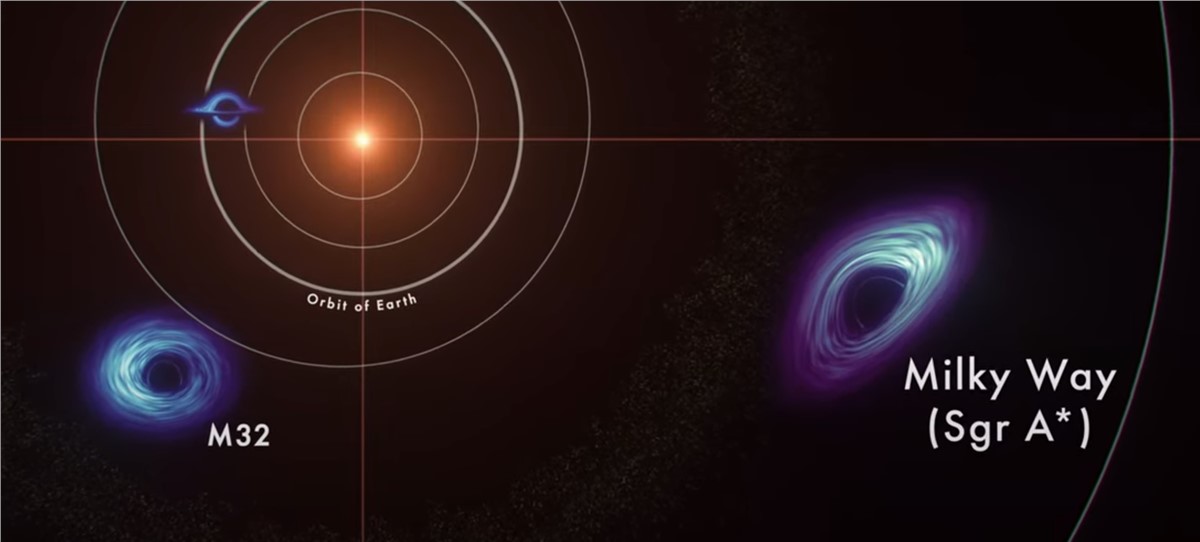
NASA’s latest animation showcases the sheer enormity of supermassive black holes, which can contain anywhere between 100,000 and tens of billions of times more mass than our Sun. These colossal entities are found at the center of most large galaxies, including our own Milky Way. Direct measurements, many of which were taken with the help of the Hubble Space Telescope, have confirmed the presence of over 100 supermassive black holes. But how do they get so big? When galaxies collide, their central black holes eventually merge together too.
The Event Horizon Telescope, a planet-spanning network of radio observatories, produced the first images of giant black holes at the centers of M87 and the Milky Way in 2019 and 2022 respectively. These images revealed a bright ring of hot orbiting gas surrounding a circular zone of darkness. Any light crossing the event horizon – the black hole’s point of no return – becomes trapped forever, and any light passing close to it is redirected by the black hole’s intense gravity. Together, these effects produce a “shadow” about twice the size of the black hole’s actual event horizon.
The new NASA animation showcases 10 supersized black holes that occupy center stage in their host galaxies, including the Milky Way and M87, scaled by the sizes of their shadows. Starting near the Sun, the camera steadily pulls back to compare ever-larger black holes to different structures in our solar system.
The animation shows two monster black holes in the galaxy known as NGC 7727. Located about 1,600 light-years apart, one weighs 6 million solar masses and the other more than 150 million Suns. Astronomers say the pair will merge within the next 250 million years.
“Since 2015, gravitational wave observatories on Earth have detected the mergers of black holes with a few dozen solar masses thanks to the tiny ripples in space-time these events produce,” said Goddard astrophysicist Ira Thorpe. “Mergers of supermassive black holes will produce waves of much lower frequencies which can be detected using a space-based observatory millions of times larger than its Earth-based counterparts.”
That’s why NASA is collaborating with ESA (European Space Agency) to develop their LISA mission, the Laser Interferometer Space Antenna, expected to launch sometime in the next decade. LISA will consist of a constellation of three spacecraft in a triangle that shoot laser beams back and forth over millions of miles to precisely measure their separations. This will enable the detection of passing gravitational waves from merging black holes with masses up to a few hundred million Suns. Astronomers are exploring other detection techniques to tackle even bigger mergers.
At the animation’s larger scale lies M87’s black hole, now with an updated mass of 5.4 billion Suns. Its shadow is so big that even a beam of light – traveling at 670 million mph (1 billion kph) – would take about two and a half days to cross it.
The movie ends with TON 618, one of a handful of extremely distant and massive black holes for which astronomers have direct measurements. This behemoth contains more than 60 billion solar masses, and it boasts a shadow so large that a beam of light would take weeks to traverse it.




 Copyright 2023 All rights reserved.