

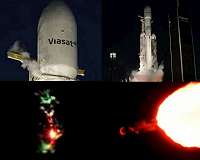
On April 30, 2023, SpaceX launched the ViaSat-3 Americas satellite and two smaller communications satellites, Arcturus and GS-1, from Launch Complex 39-A (LC-39A), Kennedy Space Center, Florida. The launch was delayed due to severe weather and technical issues. The satellites were placed in a circular orbit near a geostationary altitude of over 20,000 miles above Earth. The Boeing-built ViaSat 3 Americas satellite is the first of three new-generation broadband satellites for the California-based company Viasat. It will beam internet signals to underserved consumers, businesses, and governments. The secondary payload Arcturus is Astranis Space Technologies’ first commercial satellite. Weighing around 660 pounds, it can deliver data capacity of up to 7.5 Gbps for Alaska and the surrounding region. Another small rideshare payload on Falcon Heavy is a CubeSat that will be operated by Washington-based Gravity Space’s GS-1 microsatellite, hosting multiple payloads, including an Indonesian satellite Nusantara-H1-A to help retain regulatory rights to a geostationary orbital slot. It’s the first launch ever in which SpaceX intentionally expended all of the three first stage boosters on a Falcon Heavy rocket, meaning none of the three boosters will be recovered. SpaceX deployed the roughly 13,000-pound ViaSat 3 Americas satellite and its co-passengers into a six-hour near-geosynchronous orbit using all of the rocket’s fuel, requiring three burns by the upper stage engine.


 Copyright 2023 All rights reserved.