

The European Space Agency (ESA) has launched a campaign to invite ideas for the extraction of resources from the moon. The initiative, which is part of the In-Situ Resource Utilisation (ISRU) programme, aims to identify knowledge and technical gaps in the current lunar space resources value chain. The campaign will define future contests supported by ESA in partnership with the European Space Resources Innovation Centre in Luxembourg. The gaps identified will serve as the basis to define the themes of the next ESA and ESRIC Space Resources Challenges. The solutions identified could be tested on the ISRU Pilot Plant, an end-to-end terrestrial demonstrator plant intended to validate all necessary ISRU steps in practical terms, on Earth, and then, potentially one day, in space.
Hydroponic farming therefore offers a practical alternative; this type of agriculture involves feeding plant roots directly with nutrient-rich water, without the need for soil. The potential is still there however to put lunar regolith to work, on the basis of ‘in-situ resource utilisation’ – or living off the land.
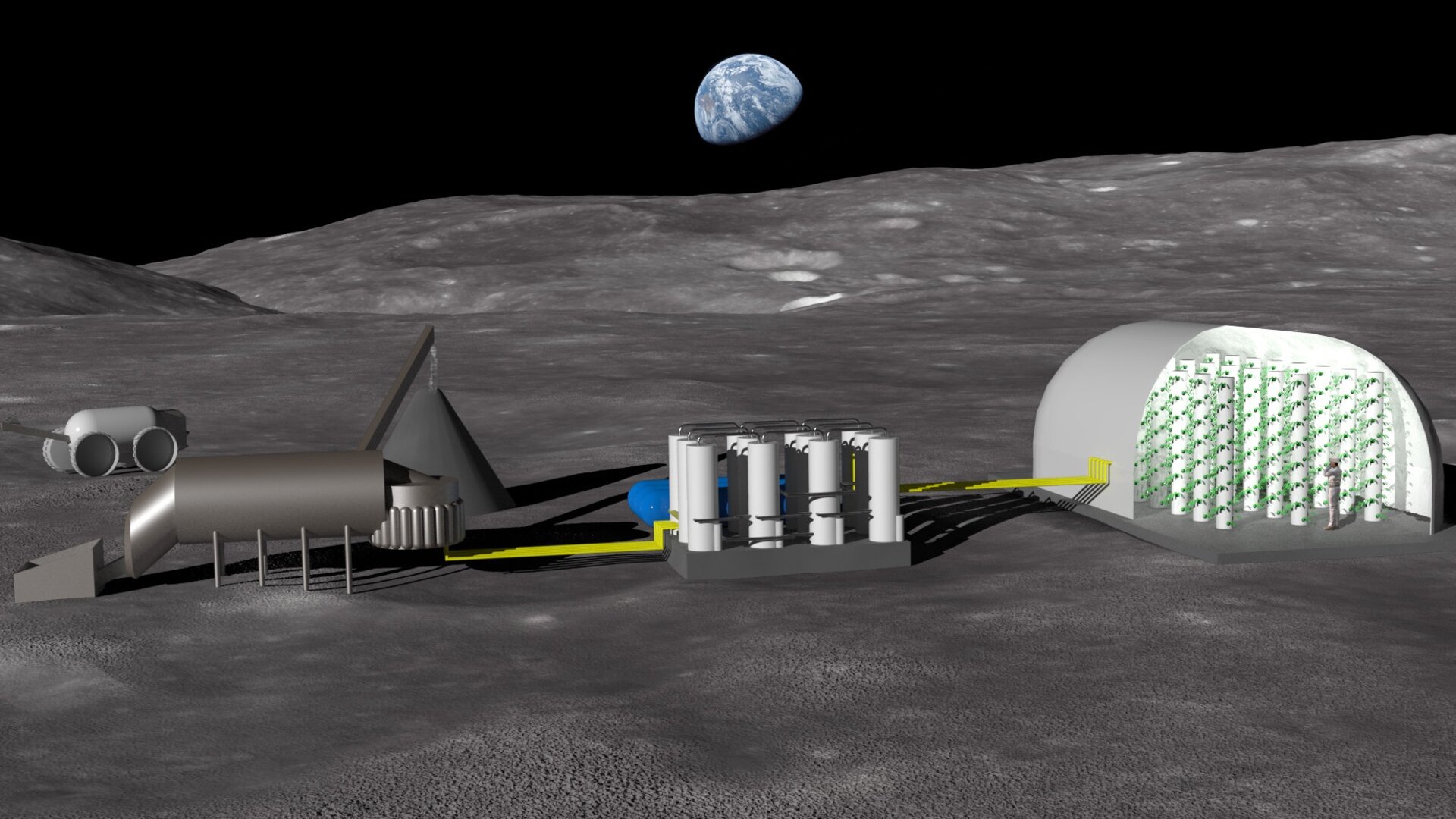
The ‘Enabling Lunar In-Situ Agriculture by Producing Fertilizer from Beneficiated Regolith’ project, led by Solsys Mining with Norway’s Geotechnical Institute (NGI) and Centre for Interdisciplinary Research in Space (CIRiS), involves studying a combination of mechanical, chemical and biological processes to extract mineral nutrients from the regolith. Valuable elements might need concentrating before use, while undesirable ones would be removed.
The left of this artist’s impression shows a mechanical sorting area for the regolith, passing through to the central module for more advanced processing, such as chemical leaching. Finally extracted nutrients would be dissolved in water to be pumped to the hydroponic garden, right.
“This work is essential for future long-term lunar exploration,” comments ESA materials and processes engineer Malgorzata Holynska. “Achieving a sustainable presence on the Moon will involve using local resources and gaining access to nutrients present in lunar regolith with the potential to help cultivate plants. The current study represents a proof of principle using available lunar regolith simulants, opening the way to more detailed research in future.”
The Solsys Mining team is optimistic, having already cultivated beans using simulated lunar highland regolith as a nutrient source.
The project came about as an idea submitted through ESA’s Open Space Innovation Platform, seeking out promising new ideas for space research. It is now being funded by the Discovery element of ESA’s Basic Activities.


