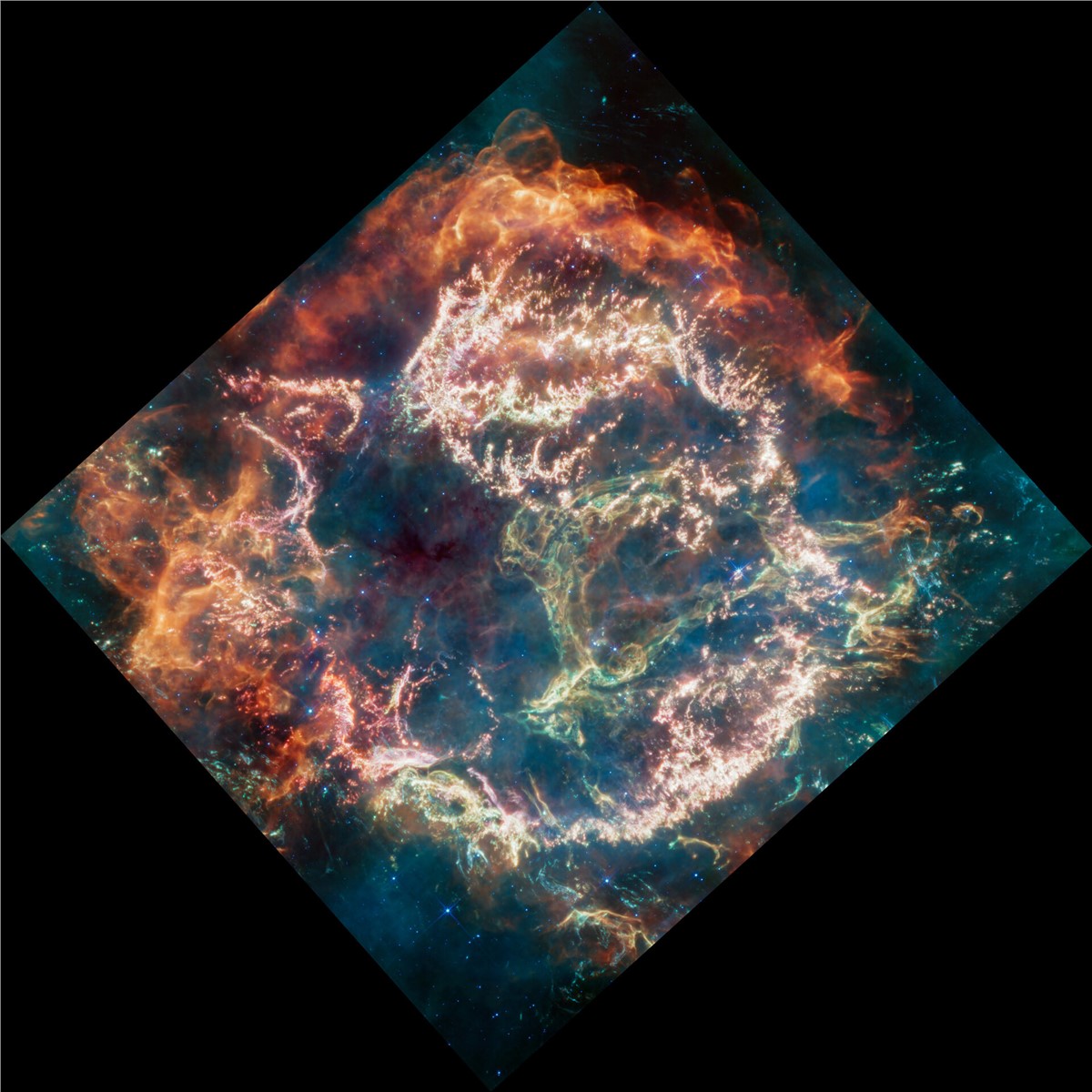
The James Webb Space Telescope has captured a stunning mid-infrared image of the supernova remnant Cassiopeia A (Cas A), created by a massive star explosion 340 years ago. The image displays vivid colours and intricate structures that offer astronomers an opportunity to perform stellar forensics to understand the star’s death. Cas A is the youngest known remnant of an exploding, massive star in our galaxy, making it a prototypical supernova remnant that has been widely studied by a number of ground-based and space-based observatories. The multi-wavelength observations can be combined to provide scientists with a more comprehensive understanding of the remnant.
The striking colours of the new Cas A image, in which infrared light is translated into visible-light wavelengths, hold a wealth of scientific information that researchers are just beginning to tease out. Among the science questions that Cas A may help answer is: Where does cosmic dust come from? Observations have found that even very young galaxies in the early universe are suffused with massive quantities of dust. It’s difficult to explain the origins of this dust without invoking supernovae, which spew large quantities of heavy elements (the building blocks of dust) across space.
However, existing observations of supernovae have been unable to conclusively explain the amount of dust we see in those early galaxies. By studying Cas A with Webb, astronomers hope to gain a better understanding of its dust content, which can help inform our understanding of where the building blocks of planets and ourselves are created.
Supernovae like the one that formed Cas A are crucial for life as we know it. They spread elements like the calcium we find in our bones and the iron in our blood across interstellar space, seeding new generations of stars and planets. The Cas A remnant spans about 10 light-years and is located 11,000 light-years away in the constellation Cassiopeia.