

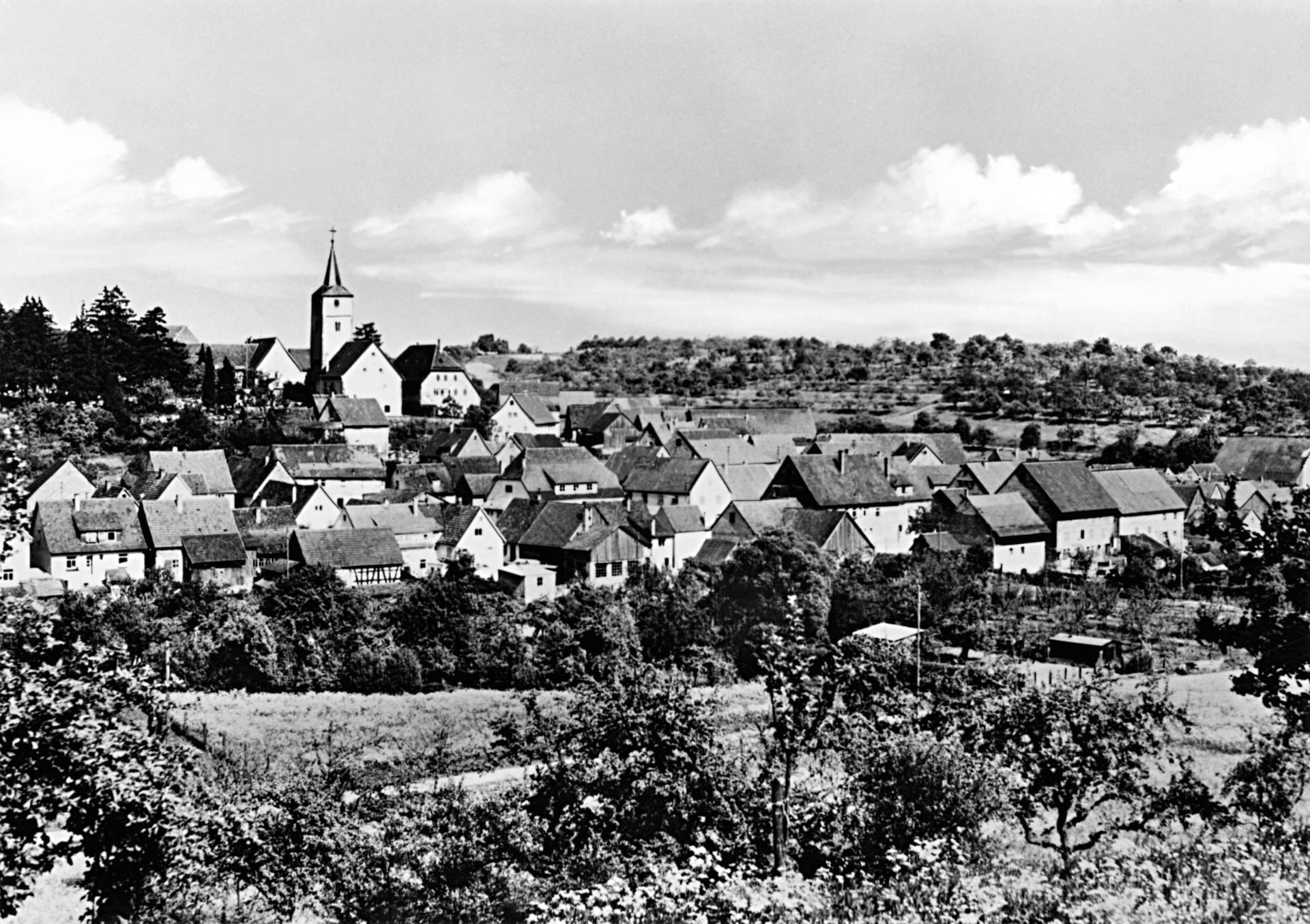

Adense forest almost conceals the entrance. Individual buildings can be seen through the greenery. The trees rustle. Suddenly, a deafening, thunderous roar breaks the silence. A short while later, a white cloud of steam rises above the canopy of leaves. The roar is over just minutes later, and the birds resume their singing as though nothing has happened. They seem to be familiar with the hustle and bustle of the Harthausen Forest. DLR’s Lampoldshausen site is located 25 kilometres north of Heilbronn, in northern Baden-Württemberg, Germany. The propulsion systems that will launch future rockets into space have been tested here for 60 years.
Anyone who visits DLR site Lampoldshausen is setting foot in one of the most important places in European space history. The 51-hectare site is a hub of modern engine development with strong historical connections. In 1959, the space pioneer Eugen Sänger established a research institute in the Harthausen Forest. Sixty years after its inception, it still bears the traces of its history, while offering tantalising glimpses of the future. Even if some of the test stands at the Institute of Space Propulsion located here exhibit some patina, they have not become worn out. More versatile than ever before, they are well prepared for the new requirements of European space transport systems.
Prologue: Starting with Turbulences
Spontaneous applause arose in the Lampoldshausen Town Hall on this autumn evening of 10 October 1959. Professor Eugen Sänger, renowned astronautics visionary and scientist, was happy: His thrilling speech had convinced the Lampoldshausen citizens of the importance of the planned test site for rocket engines in their community, situated 25 kilometers north of Heilbronn. Thus, he had taken the last hurdle. Now, the way was paved for erecting rocket test facilities, streets, fuel storage tanks and an office building on the property. Sänger had reached his goal.
1923 – 1954
Between Vision and Destruction
The construction of the test site for liquid rocket engines in the Harthäuser forest aligned with a long tradition of German aerospace research: already in the twenties visionaries like Hermann Oberth, Rudolf nebel or Wernher von braun had set up theories for the construction of rockets carrying out first tests, too. During the Second World War under the national Socialists rocket technology was developed further for military purposes. In October 1942 in Peenemünde the A4 was the first large-scale rocket on the globe, which was launched almost 100 kilometres into outer space. After the end of the Second World War many scientists left Germany and went to live abroad, especially to the USA, the Soviet Union and to france. They fell back to the experience and research results gained in Peenemünde when conceiving new rockets. While rocket research and development flourished throughout the victorious powers, space research stopped due to the ban pronounced by the Allied control council in Western Germany. Already in the fifties there were the first indications for the ban being lifted.
1954 – 1963
From FPS to European Integration: Building up Lampoldshausen
In 1954 Eugen Sänger, a leading aerospace and rocket technology scientist returned from france to Germany to resume his research there. It was the ideal time with the ban on rocket research lifted after the withdrawal of the occupational troops. from 1955 onwards rocket research was no longer prohibited, and Western Germany was back to aerospace research after ten years of exclusion. All federal countries, universities and the industry wanted to have a share in this ‘founding phase’. first, Sänger founded the Stuttgart ‘Forschungsinstitut für Physik der Strahlantriebe’ (FPS), the Research Institute for Jet Propulsions. In 1957 he started to search an appropriate test site for liquid-fuel gas propulsions for his institute; he found a place close to Heilbronn in the Harthäuser forest. The German Land Baden-Wuerttemberg supported him and made the area available for his plans. In autumn 1959 Sänger could even convince the sceptics among the Lampoldshausen inhabitants. In April 1960 the test site was expanded. Two years later the first test facilities were ready for operation, and first tests could be carried out on behalf of a national rocket program. At this time, Sänger had already withdrawn from his steering function at the Stuttgart Institute.
1963 – 1973
European Aerospace Starts off: the ELDO program
The first expansion stage of the test site was accomplished in 1963. In the same year Lampoldshausen was selected for the first European space flight project. In the framework of ELDO the federal Government of Germany participated in the development of a European carrier rocket. ‘Astris’, the propulsion system, laid out for the third rocket stage had to be tested in Lampoldshausen. This is why the area needed to be expanded. The new facilities P3 and P4 were perfectly suitable for testing the conditions on the ground and in the air. In parallel, the Lampoldshausen scientists and engineers conducted research for high-energy liquid propulsions. However, administrative issues and differences of opinion within ELDO lead to a failure of the “Europe rocket” project in 1973. Lampoldshausen ended up in a crisis that could be bridged with smaller projects.
1973 – 1988
An Access to Outer Space for Europe: The Ariane Success Story
Soon after the ending of the ELDO program people in Europe were convinced that an own access to space was indispensable to carry out common European satellite programs independently. The work on the new carrier rocket Ariane was headed and initiated by newly established ‘European Space Agency’ (ESA) in 1975. Lampoldshausen conducted the necessary tests of the Viking engine. Ariane was successfully launched on 24 December 1979, and a success story commenced. This European rocket was continuously refined to carry increasingly heavy-weight satellites up to Ariane 4. With the merchandising activities of Arianespace, founded in 1980, Ariane became the global market leader in commercial carrier systems. Lampoldshausen conducted the Ariane tests but was also involved in the development of a reusable orbital glider and an energy-saving boiler firing method.
1988 – 2004
Vulcain, Aestus and Vinci: DLR Lampoldshausen Heading for the New Millenium
In 1996 the first launch of an Ariane 5 rocket occurred. The program was already concluded in 1987. Ariane 5 was intended to launch different loads into space with great reliability and the lowest possible costs, and hence strengthen the market position of European Space flight. DLR Lampoldshausen participated intensively in the development of the Ariane 5 rocket. Because of the requirements for the new engine test, the site was expanded and retrofitted. Consequently the engineers and technicians at Lampoldshausen built the large-scale test facility P5 and retrofitted P4.1 and P4.2. The modern engine test facilities provide reliable test data on the upper stage engines of the Ariane 5. With its program Lampoldshausen 2000+ the location has also been closely gearing its research and utilisation to fulfil the requirements of future European Space flight programs since the end of the 1980s. For instance, amongst other things tests on high-pressure combustion are being conducted at the newly built research test facility P8. In future DLR Lampoldshausen will also continue to be indispensable for the European space flight industry.
2004 – 2014
Vinci and Ariane 5 ECA: A scuccess story to be continued
In 2005, the new Ariane 5 ECA successfully launched into space for the first time – with the Vulcain 2 main stage engine developed on the P5 test bench. For the then envisioned Ariane 5 ME, DLR engineers also tested the new re-ignitable Vinci upper stage engine under altitude conditions on the P4.1 from 2005 onwards. Meanwhile, the proven Aestus engine was further developed on the P4.2. In the upper stage of the new Ariane 5 ES it then took ESA’s unmanned space freighter ATV to the International Space Station ISS five times starting in 2008. Lampoldshausen was also intensively dedicated to young scientists and engineers. The DLR_School_Lab was founded in 2005 and construction of the M11.5 student test field began in 2012. Finally, in 2013, the DLR Space Propulsion Forum opened and has attracted numerous visitors with its exhibition since then.
2014 – 2019+
Ariane 6 and test stand P5.2: Securing the future
The future of DLR Lampoldshausen already began in 2014, as ESA decided to develop the Ariane 6 and the construction of the new P5.2 stage test facility started. In 2016, the Vinci tests on P4.1 were transferred to the Ariane 6 program, and in 2018, a challenging parallel operation took place with the final flight qualification of Vinci and the development tests of the new Vulcain 2.1 main stage engine at P5. In the same year, the 100th Ariane 5 flight and the last launch with an Aestus engine tested at P4.2 for the Galileo navigation system happened. Looking further ahead, a first technology demonstrator for the newly planned LOX/Methane Prometheus engine was tested at the P3 as early as 2016, and a third test cell for tests of a complete propulsion at system level has been built on the P8 test facility since 2018. A glimpse into the future reveals the first upper stage tests on P5.2 in 2020 and the subsequent first launch of Ariane 6.
The many facets of future space propulsion – including methane
Before a launcher is qualified for launch, its engines undergo several thousand seconds of test firings on purpose-built test stands. In Lampoldshausen, they receive the finishing touches. One of the core tasks of this site over the coming years will be to develop the test stands in a technologically flexible way and to optimise their cost-effectiveness. In addition, DLR engineers are constantly working on developing new technologies for future engine concepts. One example is the propellant combination of methane and liquid oxygen (LOX), which is playing a promising role in the development of new, liquid-fuelled space propulsion systems. In the Prometheus project, DLR researchers are working to ensure that LOX/methane technology will soon be ready for use in European spaceflight systems. It will be tested on the site’s P5 test stand, demonstrating that these large structures remain ground-breaking, despite having been constructed during the facility’s early years. P5 was originally built for the development of the Vulcain main-stage engine of Ariane 5 and went into operation in 1990. Development tests on the Vulcain-2.1 engine for the new Ariane 6 are currently taking place on this stand.
Behind the scenes, however, a team of DLR scientists is already preparing the test stand for its new task and developing the necessary infrastructure for the Prometheus project. “A LOX/methane technology demonstrator with 100 tonnes of thrust will be put through its paces on the P5 test stand from 2020,” says Anja Frank, Head of Test Facilities. “A smooth and swift transition to LOX/methane from the traditional propellant combinations used in current engines – liquid hydrogen and liquid oxygen – is essential to ensure that Europe remains competitive in the launcher sector after Ariane 6.” A future LOX/methane engine can reduce the costs of the European main-stage Vulcain engine – which was developed in the 1980s – by a factor of 10 and be reusable.
The future of propellants is emerging at DLR Lampoldshausen
Future propellants are also an important part of the research being carried out in the Harthausen Forest. Until now, satellite propulsion systems have used hydrazine. This propellant can be stored for long periods of time and works reliably even under space conditions, making it indispensable for space missions today. However, it is also harmful to human health, and handling hydrazine on the ground – during transport, fuelling and launch preparations – is complex and expensive. This is why DLR researchers are now analysing, evaluating and testing new fuels, referred to as ‘green propellants’. These are environmentally friendly, cost-effective and easy to handle, and in the future they will be at least as efficient as conventional propellants.
Getting closer to next-generation engines through machine learning
Artificial intelligence (AI) is playing an increasingly important role in the space propulsion sector, in order to accelerate the development of new generations of engines. Machine-learning algorithms can independently develop predictive capabilities using previously generated data, and these can then be used for data-based calculations, decisions and optimisations. However, these kinds of developments at the site remain invisible to the group of visitors. They are happening on computers in the offices, including those of Jan Deeken and Günther Waxenegger-Wilfing from the System Analysis group at the Institute of Space Propulsion. They are using neural networks as part of the Liquid Upper stage deMonstrator ENgine (LUMEN) project, in which the experts at Lampoldshausen are investigating the interactions between all the components of a rocket engine – from the combustion chamber to the turbopumps and valves. A complete model engine for research in a test stand environment is due to be created for the first time by the end of the project in 2020. “One big advantage is that we no longer have to wait for days to get the results of calculations. The new ‘tool’ enables us to combine the speed of simple modelling with the accuracy of numerical methods, and provides us with results in seconds. This has given us new insights into the interactions between components in a rocket engine,” says Deeken. AI has already proven beneficial in the design of combustion chamber cooling channels. A neural network trained for this purpose is able to predict the complex behaviour of methane – which is used as a coolant, as well as a propellant – and is thus a central component of automated cooling-channel design for the LUMEN combustion chamber.


 Copyright 2023 All rights reserved.